Imagine you have three credit cards, with three balances, three interest rates and three due dates. A lender offers you one personal loan that would pay off all three. Instead of juggling several accounts, you would make one fixed payment each month.
That sounds simpler, and it may be. But debt consolidation does not erase debt. It replaces several debts with a new one. Whether that improves your situation depends on the interest rate, the fees, the length of the loan and, above all, what happens to the cards after they are paid off.

What a debt consolidation loan actually does
A debt consolidation loan is a new loan you use to pay off several existing debts. For example, suppose you owe:
| Debt | Balance |
|---|---|
| Credit card A | $3,000 |
| Credit card B | $2,500 |
| Credit card C | $2,500 |
| Total | $8,000 |
Example balances used throughout this lesson.
You could borrow $8,000 with a personal loan and use it to pay off the three cards. From then on, you repay the personal loan with its own interest rate, monthly payment and term.
So the real question is not “three payments or one?”. It is: what would my current debts still cost me, and what will the new loan cost me in total?
MONEY TRAPWhy one payment feels like less debt
“My cards are at zero and I only have one payment now. I finally feel out of debt.”
The debt has moved to a new loan, not disappeared. And empty cards can start to feel like money to spend. In one large U.S. study, many people’s card balances came back close to their old levels within 18 months.
Why consolidation can feel like more progress than it is
Consolidation often brings real relief: fewer bills, one due date and a clear end date. That relief is useful. But it can also make the situation feel better than the numbers say.
One payment feels like less debt
Three bills feel heavier than one, even when the total owed is exactly the same. When the old cards show $0, it is easy to feel that the problem is solved. In reality, the $8,000 is still there, just in a different place, and now it has a new schedule.
Empty cards can start to feel like spending money
Once the cards are paid off, their full limits are available again. For many people, that space starts to feel like money they have, not credit they could borrow. This is where consolidation often goes wrong.
A TransUnion study of U.S. borrowers found that people who used a personal loan to pay off credit cards cut their card balances by 57% on average. However, for many of them, those balances had returned close to their previous levels 18 months later. At that point they had the new loan and the card debt.
A lower payment feels like saving money
If the new loan has a lower monthly payment than your cards, it can feel like you are saving. But a lower payment often comes from a longer term, not a cheaper loan. As we explain in How to Compare Loan Offers, people tend to focus on the monthly number and pay less attention to the total cost.
The fix is to decide what happens to the cards before you sign. For example, keep them at home, remove them from online shops and payment apps, or ask yourself honestly whether you can leave them unused.
How the consolidation process works
The process usually follows these steps:
- Get the exact payoff amount for each debt. It can be slightly different from the balance in your app, because interest keeps adding up and some fees or charges may not appear yet.
- Apply for the loan. The lender may look at your credit history, credit scores, income, existing debt payments, the amount you want to borrow and the length of the loan.
- Review the offer. It should show the loan amount, APR, monthly payment, term and fees.
- Receive the money or let the lender pay your creditors. Some lenders deposit the money in your account, others pay your cards directly, and some do a mix of both.
- Confirm every old debt is at zero. Keep checking the old accounts, and keep making any required payments, until each one shows a zero balance. A small amount of leftover interest can appear after the payoff.
Which debts should you include?
Consolidation loans are often used for credit cards, some personal loans, certain medical bills and store cards. But the fact that you can include a debt does not mean you should. Look at this example:
| Debt | Balance | Current APR |
|---|---|---|
| Credit card | $5,000 | 24% |
| Personal loan | $2,000 | 8% |
| Medical payment plan | $1,000 | 0% |
Hypothetical example.
A new loan at 13% would make the credit card cheaper. It would not improve the 8% personal loan, and it would make the 0% medical plan more expensive. You do not have to consolidate everything. Often it makes sense to include only the debts that cost more than the new loan.
Be extra careful if the offer involves your home, your car or other property as collateral, federal student loans, a temporary promotional rate, or debt that already has good protections. Turning unsecured debt into secured debt changes the risk, as explained in Secured vs. Unsecured Loans. The Federal Trade Commission warns that some consolidation loans use your home as collateral, and missing payments could put your home at risk.
What to compare before accepting a loan
The monthly payment is only one part of the offer. Check each of these:
| Feature | Question to ask |
|---|---|
| Loan amount | Is it enough to cover the real payoff amounts? |
| Interest rate | Is it fixed or variable? |
| APR | What borrowing costs does it include? |
| Origination fee | Is it added to the loan or taken from the money you receive? |
| Monthly payment | Does it fit comfortably in your budget? |
| Term | How many months will you be paying? |
| Total of payments | How much will you repay in total? |
| Early repayment | Can you pay it off early without a penalty? |
| Late fees | What happens if you miss a payment? |
| Collateral | Could you lose an asset if you cannot pay? |
Compare APR with APR, and look at every fee in dollars.
For most consumer loans with fixed payments, the Truth in Lending Act requires lenders to show the finance charge, APR, amount financed, total of payments and payment schedule. Compare offers with similar terms, because a three-year and a five-year loan can look very different even at the same rate.
How the loan term changes the real cost
Here is an $8,000 fixed-rate loan at 12% APR with no fees, repaid over three or five years:
| Loan term | Monthly payment | Total of payments | Total interest |
|---|---|---|---|
| 36 months | $265.71 | $9,565.72 | $1,565.72 |
| 60 months | $177.96 | $10,677.33 | $2,677.33 |
Original Money Behaves calculation. Fixed rate, equal monthly payments and no fees.
The five-year loan lowers the payment by about $88 a month, but it keeps you in debt two more years and costs about $1,112 more in interest. Neither option is right for everyone. A payment you cannot keep up is not useful, but choosing the smallest payment without looking at the term can make an expensive loan look affordable.
A simple habit helps: before you decide, write the two numbers next to each other. Monthly payment: $177.96. Total repayment: $10,677.33. Both describe the same loan.
Origination fees can leave you short
Some lenders charge an origination fee. On an $8,000 loan, a 5% fee is $400. If the lender takes it out of the loan, only $7,600 reaches you, which leaves you $400 short of paying off $8,000 of cards. To pay them off completely, you would need to borrow about $8,421.
Before you accept, confirm the fee in dollars, how much money will actually be sent, how much will go to each creditor and whether any balance will be left on the old cards. Also watch for rates advertised as “starting at”, because the lowest rate is usually only for applicants with the strongest credit.
Is consolidation worth it for you?
Use the calculator below to compare the two paths with your own numbers. To keep the comparison fair, it uses the same monthly budget for both: the loan’s monthly payment.
How to use it: enter your total card debt and your cards’ APR. Then add the loan’s APR, its term in months and the origination fee as a percentage. The calculator shows how long each path takes and what it costs in interest and fees. The results update as you type.
TRY IT WITH YOUR NUMBERS
Is consolidation worth it?
Compare paying off your cards with a consolidation loan, using the same monthly budget in both cases.
KEEP PAYING THE CARDS
–
–
–
CONSOLIDATION LOAN
–
–
–
–
Simplified estimate. The loan fee is taken from the loan, so the calculator borrows a little more to pay off the full card debt. Both options use the loan’s monthly payment, with no new card spending. Real card interest is calculated daily, and real offers can include other costs.
Try a longer term or a higher fee and watch how quickly the savings shrink. Then remember the most important number of all is not in the calculator: whether your cards stay at zero.
How consolidation can affect your credit
A consolidation loan can affect your credit in several ways, and the result is different for everyone:
- Applying usually causes a hard inquiry, and the new account can lower the average age of your accounts.
- Paying off your cards can lower your credit utilization, which can help your scores.
- Paying the new loan on time builds a positive payment history. Paying late can damage your credit.
- Consolidation does not remove late payments that were already reported.
- Using the cards again raises your utilization and your total debt.
Paying off a card does not usually close it. Keeping it open preserves available credit, but it can also keep the temptation to spend. Choose the option you can manage responsibly, not the one based on a single credit score tip. Learn more in Credit Score Explained.
When consolidation helps and when it does not
It can help when the new APR is lower after fees, the term does not stretch your debt much longer, the payment fits your budget, one payment helps you stop missing due dates and you have a plan to keep the cards at zero.
It may not help when the APR is similar to or higher than what you pay now, a large fee wipes out the savings, the lower payment comes mainly from adding years, you must put up your home or car, or your budget still runs short every month.
Consolidation changes how your debt is organized. It does not fix the reason the debt built up. If your expenses are regularly higher than your income, the cards can fill up again while you are still paying the new loan. If that is your situation, a balance transfer may or may not be a better fit, as we compare in Balance Transfer vs. Debt Consolidation Loan, and a plan like the one in Debt Snowball vs. Debt Avalanche can help you pay down cards without a new loan.
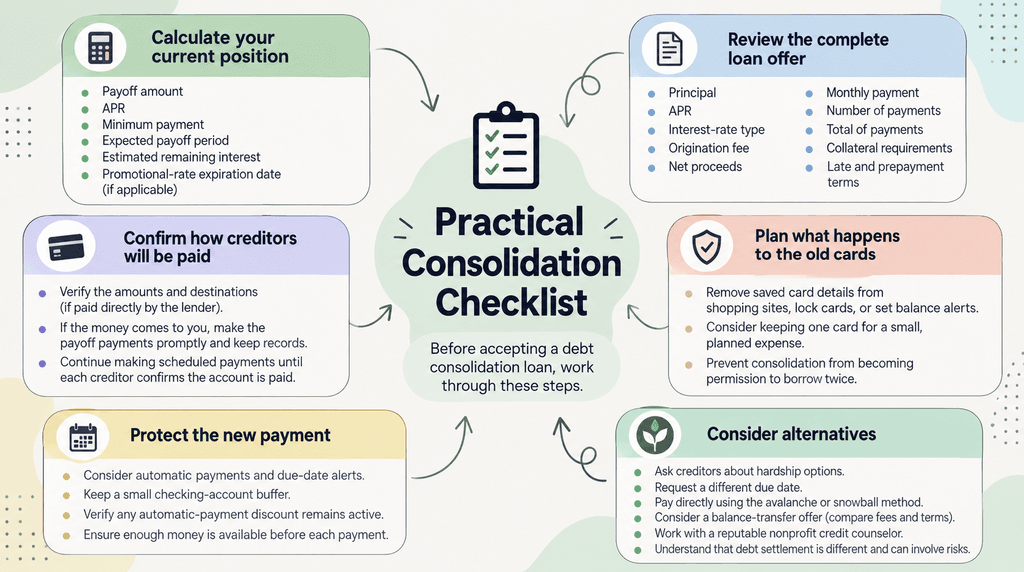
Next time you consider consolidating, check this
- Compare totals, not payments. What will your cards still cost you, and what will the loan cost in total, fees included?
- Check the money you will actually receive. Make sure it covers every payoff amount after the fee.
- Only include debts that cost more than the new loan. Leave cheaper debts as they are.
- Decide what happens to the cards before you sign. Empty cards are the biggest risk of consolidation.
- Confirm every old account is at zero. Keep checking until each one shows a zero balance.
ABOUT THE AUTHOR
Lorena founded Money Behaves. She is an economist and a psychology student who focuses on how people make money decisions: how they judge risk, react to percentages and read costs, and what happens when financial information gets complicated. She is not a licensed financial advisor, so every lesson relies on official U.S. sources and published research. See how we write and check our lessons.
Keep learning: Personal Loan vs. Credit Card Debt, Minimum Payments: Why $90 Feels Right and How Loans Work.