LOANS & DEBT · LEVEL 1 · LESSON 3
MONEY TRAPWhy a lower payment feels cheaper
“$405 a month is easier than $627, so the longer loan must be the better deal.”
A lower payment usually means more months of interest. On a $20,000 loan at 8%, five years instead of three costs about $1,770 more.
In this lesson: the numbers that matter in a loan offer, why the “best” offer can fool you, how fees and longer terms change the real cost and how to compare offers side by side.
Maya needs to borrow $10,000. One lender advertises an 8% interest rate and another offers 10%. The 8% loan looks like the obvious choice. Then Maya reads the details: the first loan charges a $500 origination fee and the second has none. The 8% loan also has the lower monthly payment, but that does not mean it costs less overall.
Loan ads usually highlight whichever number makes the offer look best: a low rate, a small monthly payment or fast approval. To compare loans properly, you need to look past that one number and check how much money you actually receive, the APR, the fees, the monthly payment, the length of the loan and the total cost.

The numbers that matter in a loan offer
Before you accept a loan, make sure you know each of these numbers. Each one answers a different question:
| Loan detail | Question it answers |
|---|---|
| Amount received | How much money will you actually get? |
| Interest rate | What rate is charged on the balance you owe? |
| APR | What is the yearly cost once interest and certain fees are included? |
| Monthly payment | How much do you have to pay each month? |
| Loan term | How long will you be in debt? |
| Total of payments | How much will all your payments add up to? |
| Upfront fees | How much do you pay before or when the loan starts? |
No single number tells the whole story. APR helps you compare costs, the monthly payment tells you whether the loan fits your budget and the total of payments shows what the loan costs over time.
You should also know whether the rate is fixed or variable, whether you have to put up something you own as collateral, what happens if you pay early and how much you would be charged for a late payment. If these words are new to you, start with How Loans Work and Secured vs. Unsecured Loans.
Why the “best” offer can fool you
Loan decisions are rarely about math alone. Lenders and sellers know that some numbers and phrases catch our attention more than others: “payments as low as”, “rates from”, “no money down”, “you’re preapproved”, “offer ends soon”. These may be true, but they point your attention to the most attractive part of the deal.
The monthly payment becomes the target
Once a salesperson asks, “What monthly payment are you comfortable with?”, that number can take over the whole conversation. The loan can then be stretched over more months until it fits your number, even if the total cost goes up a lot.
Research shows how strong this is. In Monthly Payment Targeting and the Demand for Maturity, economists Bronson Argyle, Taylor Nadauld and Christopher Palmer studied about 500,000 used car loans in the United States. They found that borrowers reacted more to the length of the loan, which changes the monthly payment, than to the interest rate. Many also chose payments at round numbers like $200, $300 or $400 a month, as if they had a fixed budget in mind and fit the loan to it.
Being approved feels like being able to afford it
Getting approved can feel like a sign that the loan is affordable. It is not. Approval only means you meet the lender’s rules. The lender does not know all your other expenses, your plans or what else your income has to cover.
Small percentages hide big dollar amounts
An 8% rate and a 10% rate look close when you see them as percentages. In dollars, the difference depends on how much you borrow and for how long. Turning rates into monthly payments, total interest, fees and years in debt makes the real tradeoff much easier to see.
Urgency makes us compare less
An offer that seems about to expire pushes you to decide fast. But a loan can affect your budget for years, so it is worth taking the time to read the written terms before you sign.
Interest rate and APR are not the same
The interest rate is the percentage used to calculate interest on what you owe. The APR, or annual percentage rate, shows the yearly cost of the loan and can include certain fees on top of interest.
For most consumer loans with fixed payments, federal Truth in Lending rules require the lender to show you the amount financed, the finance charge, the APR, the total of payments and the payment schedule. The Federal Reserve’s Regulation Z describes the APR as the cost of your credit as a yearly rate.
If a loan has no qualifying fees, its APR will be close to its interest rate. If it does, the APR will be higher. That is why you should compare APR with APR, not one lender’s APR with another lender’s interest rate, and try to compare offers with similar amounts and terms. Keep in mind that the APR does not include everything, such as late fees or optional add-ons.
How fees can flip the decision
Back to Maya. She receives $10,000 from either lender and repays it over 36 months:
| Offer A | Offer B | |
|---|---|---|
| Interest rate | 8% | 10% |
| Monthly payment | $313.36 | $322.67 |
| Upfront fee | $500 | $0 |
| Total paid | $11,781.09 | $11,616.19 |
| Cost above the $10,000 received | $1,781.09 | $1,616.19 |
Original Money Behaves calculation. Simplified and hypothetical. Offer A’s fee is paid separately, so Maya receives the full $10,000 from both lenders.
Offer A has the lower interest rate and the lower monthly payment. Even so, once you add its $500 fee, it costs about $165 more over the life of the loan.
Fees can also reduce the money you receive. If the lender takes the $500 fee out of the loan, you owe $10,000 but only $9,500 reaches your account. If you really need $10,000, that offer does not fully cover your need. Always check the amount you will actually receive before you compare rates.
Why a lower monthly payment can cost more
The monthly payment is the easiest number to focus on, because it hits your budget right away. A payment of $405 feels much easier than $627, while the extra cost spread over several years feels far away.
Here are two loans of $20,000 at the same 8% fixed rate, with no fees:
| Loan term | Monthly payment | Total interest | Total repaid |
|---|---|---|---|
| 36 months | $626.73 | $2,562.18 | $22,562.18 |
| 60 months | $405.53 | $4,331.67 | $24,331.67 |
Original Money Behaves calculation. Fixed rate, equal monthly payments and no fees.
The five-year loan lowers the payment by about $221 a month, but it keeps you in debt two more years and adds about $1,769 in interest.
That does not mean the shortest loan is always best. A payment that is too high can leave no room for normal expenses or surprises, and missing payments is expensive. The goal is a payment you can manage without ignoring what a longer term adds to the total. Ask yourself two questions: Can I afford this payment every month? and How much will this loan cost me in total? A good loan has to pass both.
Try it with your own loan
Use the calculator below to see this tradeoff with your own numbers. It shows how much a longer loan lowers your monthly payment, and how much more you would pay in total for that lower payment.
How to use it: enter the amount you want to borrow and the interest rate from your offer. Then type two loan lengths in months, the shorter one first, for example 36 and 60. The results update as you type.
TRY IT WITH YOUR NUMBERS
Loan term calculator
Compare a shorter and a longer loan for the same amount and rate. See how much the lower monthly payment really costs.
SHORTER LOAN
–
–
–
LONGER LOAN
–
–
–
–
Simplified estimate for a fixed-rate loan with equal monthly payments and no fees. The bars show total interest. Real offers can include origination fees and other costs, so always compare the APR and the total of payments in the lender’s disclosure.
Try stretching the longer term to 72 or 84 months, which is common for car loans. The monthly payment barely drops, but the total interest keeps climbing. That is exactly the trap of focusing only on the payment.
Fixed and variable rates need different comparisons
A fixed-rate loan keeps the same interest rate for the whole term, so your payment is usually predictable. A variable-rate loan has a rate that can change based on an index or other conditions in the contract.
A variable-rate offer may start with a lower rate or payment, which can make it look cheaper. But the first payment does not tell you what later payments could be. Before choosing one, find out:
- When the rate can first change and how often it can change
- Which index or formula sets the rate, and whether the lender adds a margin
- Whether there are caps on how much it can rise
- The highest possible rate and how high your payment could go
Comparing a fixed 9% APR with a variable rate that starts at 7% is not as simple as picking 7%. One gives you certainty, while the other moves some of the risk of future rate increases onto you.
Read the written disclosure, not just the ad
An ad is designed to get your attention. The written loan documents describe what you are actually agreeing to. Look for the APR, the finance charge, the amount financed, the total of payments and the payment schedule, and then check the rest of the agreement for:
- How the origination fee is charged, as a percentage or a flat amount
- Late fees and any penalty for paying the loan off early
- A large final “balloon” payment
- Optional add-ons such as credit insurance or debt protection, which raise the cost
- What happens to an autopay discount if you cancel autopay
- Whether your car, home, savings or other property secures the loan
The written offer should match what you were told. If an important number or condition is different, stop and understand why before you accept.
Compare offers using one table
Loan documents can feel overwhelming because the key numbers are spread across different pages. Putting every offer into the same table makes the differences easy to see.
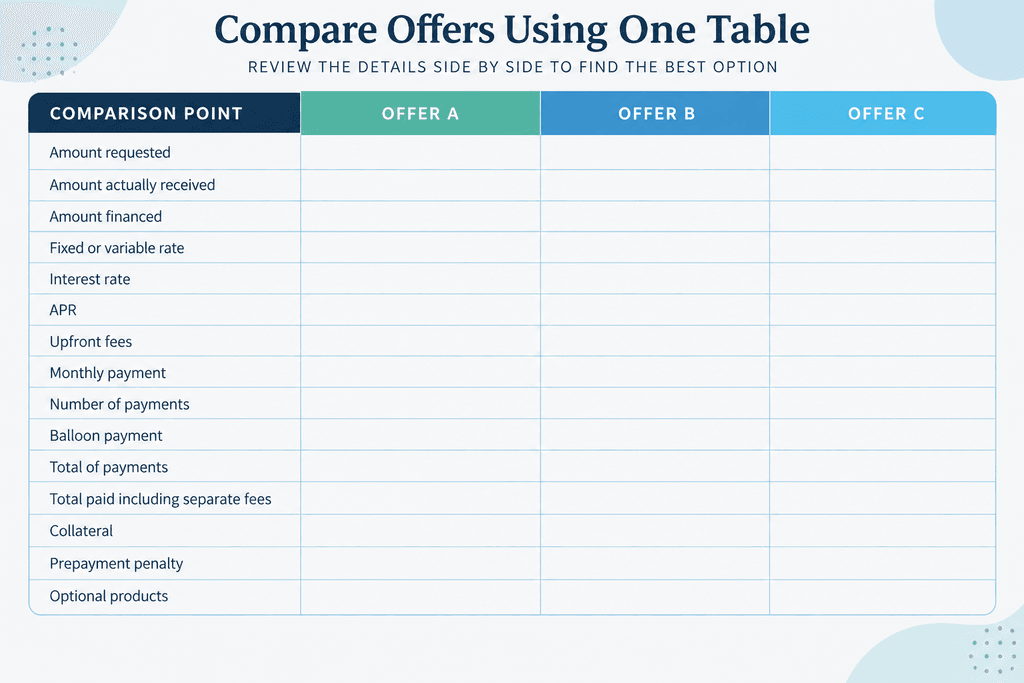
For a standard fixed-rate loan, you can make a quick estimate in three steps:
- Monthly payment × number of payments = total of scheduled payments
- Scheduled payments + separate upfront costs = total paid
- Total paid − amount you actually receive = what the loan costs you
These steps may not capture every feature of a complex loan, such as mortgages, variable rates or balloon payments. The table does not replace the official disclosure, but it puts several pages of information into one clear view. If you are thinking about a loan to pay off other debts, read How a Debt Consolidation Loan Works, Personal Loan vs. Credit Card Debt and Balance Transfer vs. Debt Consolidation Loan.
Next time you compare loan offers, check this
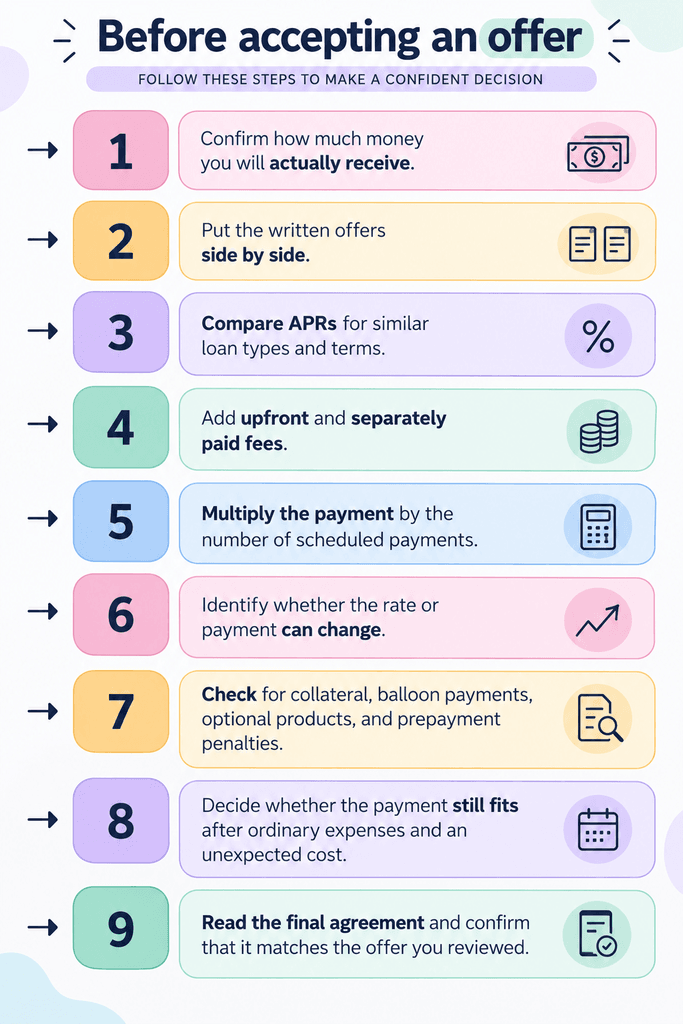
- Ignore the headline number first. Write down the amount received, APR, fees, monthly payment, term and total of payments for every offer.
- Compare APR with APR. Not one lender’s APR with another lender’s interest rate.
- Ask what the lower payment costs. If a longer term lowers the payment, check how much more you pay in total.
- Do not let approval or urgency decide for you. Being approved is not the same as being able to afford it.
- Ask for anything unclear in dollars. If one number is confusing, ask the lender to explain it in dollars before you sign.
ABOUT THE AUTHOR
Lorena founded Money Behaves. She is an economist and a psychology student who focuses on how people make money decisions: how they judge risk, react to percentages and read costs, and what happens when financial information gets complicated. She is not a licensed financial advisor, so every lesson relies on official U.S. sources and published research. See how we write and check our lessons.
Keep learning: How Loans Work, Minimum Payments: Why $90 Feels Right and Credit Score Explained.