Your credit card app shows what is happening in your account right now. A monthly statement, on the other hand, is a fixed record of a billing cycle that has already closed. As a result, purchases made after the closing date can appear in your current balance without being part of the bill that is due.
Most people only glance at the amount due and then move on. However, the statement also shows the deadline, the transactions included, any fees and interest, and notices that can change what the card costs. So in this guide, we read a statement in a useful order, with an interactive example you can explore part by part.
THE SHORT ANSWER
If you only have two minutes, then check these three things on page one:
- Statement balance: pay this amount to generally avoid interest on purchases.
- Payment due date: otherwise, a late payment can bring a fee.
- Minimum payment warning: also, it shows what paying only the minimum would really cost.
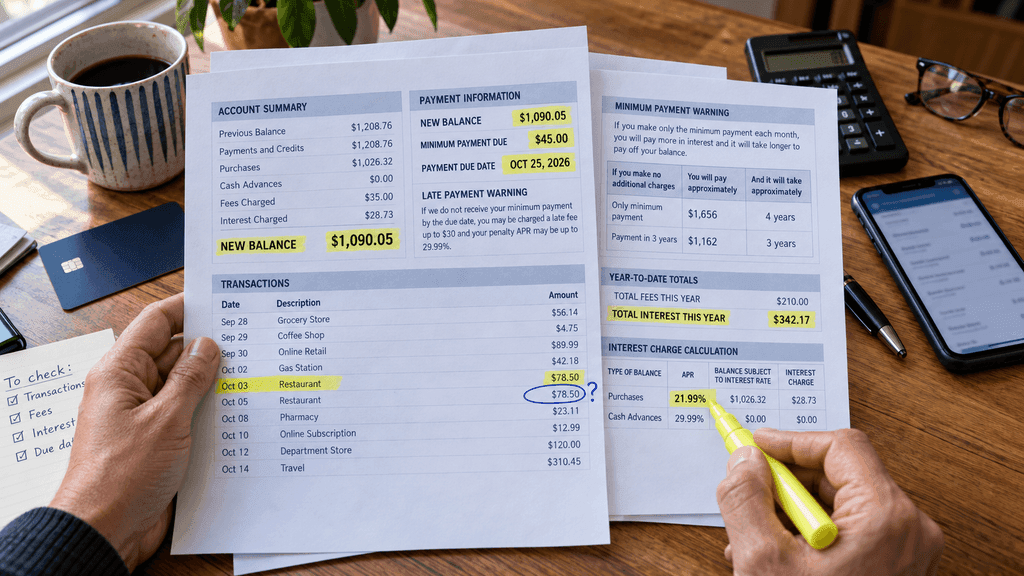
Explore a statement, part by part
Of course, every issuer uses its own layout. Still, federal rules in Regulation Z require statements to show the same core information, such as the previous balance, transactions, interest rates, fees and the payment due date. So once you know the six main parts, you can read almost any statement.
How to use it: tap or click any numbered part of the sample statement below. Then the panel next to it explains what that part means and what to check.
Hypothetical statement. Tap or click each numbered part to see what it means.
Start with the dates and the amount due
First, the payment box on page one matters most, because a mistake here has immediate consequences. In particular, the statement balance (often called the new balance) and the minimum payment answer different questions. The minimum keeps the account current, while the statement balance is everything you owed when the cycle closed.
For example, suppose your statement closed on August 31 at $840, and on September 5 your app shows $965 because of a new $125 purchase. In that case, the $840 belongs to this statement, while the $125 joins next month’s. Likewise, the closing date decides which activity the statement includes, whereas the due date decides when your payment must arrive. Also, if these numbers are new to you, see How Credit Cards Work.
Check that the summary adds up
Next, the account summary explains how the balance moved during the cycle. For example, a simple way to check it is:
Previous balance − payments − credits + purchases + fees + interest = new balance
| Account activity | Amount |
|---|---|
| Previous balance | $1,200 |
| Payment received | −$1,200 |
| Merchant refund | −$50 |
| New purchases | +$890 |
| Fees and interest | $0 |
| New balance | $840 |
Hypothetical Money Behaves example, so it does not represent a real account.
If the total does not make sense, however, timing is often the reason. For instance, a payment or refund that posts after the closing date will appear in your app but count on the next statement. Also, remember that a scheduled payment is not the same as a payment that actually went through.
Review every transaction
After that, compare each line with your receipts or order confirmations, including purchases by any authorized users. However, store names can look different on a statement. For example, a café might appear under its payment processor, such as “SQ *”, and an online order under the marketplace instead of the seller.
Then look for duplicate charges, wrong amounts, canceled orders that were never refunded and subscriptions you meant to stop. Finally, check that the issuer applied every payment and refund for the right amount. If a refund arrives close to the due date, though, confirm the updated amount due rather than assuming it covers the bill.
Separate fees from interest
Fees and interest are different costs. First, a fee comes from a specific event, such as a late payment, a cash advance or a foreign purchase. Interest, by contrast, is the cost of carrying a balance, and each type of balance can have its own APR:
| Balance type | APR | Balance subject to interest | Interest charged |
|---|---|---|---|
| Purchases | 24.99% | $0 | None |
| Promotional balance transfer | 0.00% | $2,000 | $0 |
| Cash advances | 29.99% | $200 | $5.10 |
Hypothetical example, since the real charge depends on the issuer’s method and the days involved.
Also, look at the year-to-date totals for fees and interest. After all, a cost that seems small in one month can look very different once you see the whole year. Then, to see exactly how issuers calculate these charges, read How Credit Card Interest Works.
WHY THIS HAPPENS
Autopay can make the statement invisible
Of course, setting up autopay is great for never missing a due date. However, it also removes the moment when you would open the bill, look at the amount and decide how much to pay. As a result, the statement can start to feel optional.
Research suggests this matters. In a working paper on credit card autopay, economist Jialan Wang found that after customers enrolled in autopay, they became more likely to pay only the minimum and less likely to pay in full. Similarly, psychologist Dilip Soman showed in the Journal of Consumer Research that the way we pay affects how well we remember what we spent.
In short, keep autopay for the timing, and keep a short monthly review for the content.
Read the notices at the end
The transaction list is not the end of the statement, because later pages can contain information that changes what the card costs. First, the minimum payment warning shows how long repayment would take with minimum payments only, and often the payment needed to clear the balance in about three years. We explain why that box matters so much in Minimum Payments: Why $90 Feels Right.
Also, check when any 0% promotion ends, because the balance may then start building interest at the regular rate. Similarly, other notices can announce an APR or fee change, a new agreement or a change to your autopay. Finally, note the address for billing questions, since it may differ from the payment address and matters if you need to dispute a charge.
A routine for your monthly review
A short review in the same order every month makes it much harder to miss something. In fact, the steps below follow the sections of this guide:

What to do if something looks wrong
If a charge looks unauthorized, or someone may have your card details, contact the issuer right away. Meanwhile, for other mistakes, the CFPB recommends sending a written billing-error notice to the address for billing inquiries within 60 days after the issuer sent the statement with the error. In your notice, then, include your name, account number, the charge and why you believe it is wrong.
Under the Regulation Z billing-error rules, the issuer generally must acknowledge your notice within 30 days and resolve it within two billing cycles, and no later than 90 days. Meanwhile, you usually do not have to pay the disputed amount while it is under review, although you still need to pay the rest of your bill.
Common questions
Why is my statement balance different from my app balance?
Your app shows the current balance, which keeps changing all month, so it rarely matches. In contrast, the statement balance is a snapshot from the closing date, so newer purchases and payments are not included in it.
Is paying the minimum enough?
Paying the minimum keeps your account current and avoids late fees. However, the rest of the balance carries over and usually builds interest, and you may lose your grace period on new purchases.
Do I still need to read my statement if I use autopay?
Yes, because autopay only takes care of the timing. Meanwhile, reviewing the statement is still the only way to catch errors, unexpected fees or a promotion that is about to end.
ABOUT THE AUTHOR
Lorena founded Money Behaves. She is an economist and a psychology student who focuses on how people make money decisions: how they judge risk, react to percentages and read costs, and what happens when financial information gets complicated. She is not a licensed financial advisor, so every lesson relies on official U.S. sources and published research. See how we write and check our lessons.