CREDIT · LEVEL 1 · LESSON 2
MONEY TRAPWhy card spending feels smaller
“I paid with my card, so the groceries are done. Besides, the bill can wait until next month.”
In fact, the purchase is the moment you take on the debt. Meanwhile, the bill only arrives later, which makes card spending feel lighter than paying in cash.
In this lesson: how one purchase becomes a balance, what the five key numbers on your card mean, how a billing cycle works, why card spending can feel smaller and which amount to pay.
Imagine you use your credit card to buy $80 of groceries. Then the payment goes through, you take the bags home and no money leaves your checking account. At that moment, the purchase feels finished.
However, the financial part is only beginning. Your card issuer has lent you $80, so that amount now becomes part of what you owe. Later, once the billing cycle ends, the issuer sends a statement showing how much you must pay and by which date. This gap between spending and paying makes credit cards convenient, but it also explains most of the confusion around them, so in this lesson we follow one card from purchase to payment.
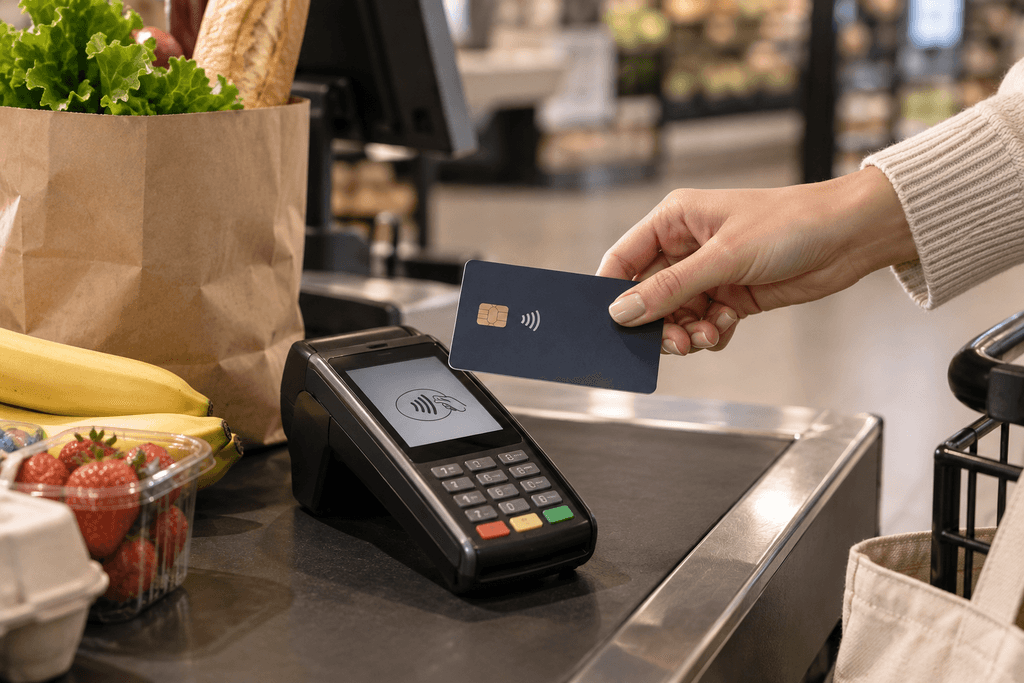
How one purchase becomes a balance
A credit card is a revolving account: the issuer gives you a credit line, and you can borrow against it again and again while the account stays open. When a purchase posts, your balance goes up and your available credit goes down. Payments work the other way around, since they reduce what you owe and free up credit once the issuer processes them.
Credit cards are also a huge part of how Americans borrow. In fact, U.S. households owed about $1.26 trillion on credit cards in mid-2026, according to the New York Fed. If you are new to borrowing in general, start with What Is Credit and How Does It Work?
Why card spending feels smaller than it is
Paying with a card also changes how spending feels, and researchers have studied this for decades. For example, in a classic study in the Journal of Consumer Research, Credit Cards as Spending Facilitating Stimuli, psychologist Richard Feinberg found that people tipped and spent more when credit card logos were simply visible nearby. In other words, the card itself can nudge us to spend.
Timing plays a part too. Economists Drazen Prelec and George Loewenstein explained in The Red and the Black, published in Marketing Science, that we enjoy a purchase more when the payment feels separate from it. Cards create exactly that separation: you get the groceries today, while the cost arrives weeks later on a statement. As a result, the purchase feels lighter than the same purchase paid in cash.

Three habits that keep spending visible
- Set your own spending limit. The bank might allow $5,000, but if your budget supports $600 of card spending a month, then $600 is your real limit.
- Count the expense when you buy. Mentally set the money aside at the register, so the later bill only settles a cost you already planned.
- Look past the minimum. For instance, a $65 minimum next to a $2,400 balance can make the debt look small, as we explain in Minimum Payments: Why $90 Feels Right.
Five numbers that answer different questions
Your card app can show several amounts at once, and each one answers a different question, as the CFPB shows in its guide to credit card statements:
| Number | Question it answers |
|---|---|
| Credit limit | What is the most the issuer will currently let me borrow? |
| Current balance | How much do I owe right now, based on posted activity? |
| Available credit | How much of my credit line is still unused? |
| Statement balance | How much did I owe when the last billing cycle closed? |
| Minimum payment | What is the smallest payment I must make this month? |
Issuers may use slightly different labels, so your statement and card agreement are the final reference.
Your limit and your current balance
The credit limit is the lender’s ceiling, not your money. So if your limit is $3,000, you have not received $3,000 of income; you have permission to borrow up to that amount. Besides, the issuer can change it under your agreement.
Next, your current balance reflects posted purchases minus payments and refunds. For instance, $300 of purchases, a $50 refund and a $100 payment leave a $150 current balance. Recent purchases may still be pending, though, so they might not appear in it yet.
Available credit, statement balance and minimum
Available credit is roughly your limit minus what you owe. For example, with a $3,000 limit and $800 in use, about $2,200 remains. Even so, that number measures how much more the bank will lend, not how much you can afford, as explained in How Credit Utilization Works.
The statement balance is a snapshot of what you owed when the cycle closed. So if a statement closes at $600 and you spend $75 the next day, your current balance rises to $675, while the statement balance stays at $600.
Finally, the minimum payment is the smallest amount the issuer requires by the due date. Paying it keeps the account current; however, the rest of the balance carries over and can build interest.
What happens during a billing cycle
In short, a billing cycle is the period that one statement covers, usually about a month. For example, imagine a cycle that runs from May 3 to June 2, with these purchases:
| Date | Purchase | Amount |
|---|---|---|
| May 6 | Groceries | $120 |
| May 14 | Gas | $50 |
| May 20 | Laptop | $600 |
| May 27 | Restaurant | $80 |
| Total | $850 |
Hypothetical Money Behaves example.
Before June 2, the cardholder also pays $200. With no earlier balance, interest or fees, the statement balance would be $850 − $200 = $650.
Closing date vs. due date
These two dates are easy to confuse, so let us separate them. First, the closing date (June 2 here) ends the billing cycle and sets the statement balance. A few weeks later comes the due date, for example June 27, which is your payment deadline.
Then, between those two dates, most cards offer a grace period on purchases. However, according to the CFPB, issuers are not required to offer one. Still, when it applies, paying the full statement balance by the due date generally lets you avoid interest on those purchases. Meanwhile, cash advances follow different rules, as explained in How Credit Card Interest Works.
Why a purchase shows as pending first
When you use your card, the store first asks the issuer to approve the charge. Until the store completes the sale, the amount shows as pending: it already lowers your available credit, but it does not count in your current balance yet. Also, hotels, gas stations and restaurants often hold an estimated amount first, which can change once the final charge posts.
Which amount should you pay?
Now imagine Logan has a $2,000 limit. His statement closed at $620, with a $35 minimum, and since then he has spent another $90. So his app shows a current balance of $710. Here is what each choice means for him:
| Logan pays | What happens |
|---|---|
| $620, the full statement balance | He generally avoids interest on those purchases, if his card has a grace period. Meanwhile, the newer $90 belongs to next month’s statement. |
| $300 | He beats the minimum, but $320 carries over and can build interest. Logan may also lose his grace period. |
| $35, the minimum | His account stays current, but $585 remains and keeps building interest. |
| Less than $35, or late | In that case, he may pay a late fee, and the late payment can hurt his credit. |
Hypothetical Money Behaves example, since the terms of each card can differ.
Paying the full current balance of $710 is also fine. In that case, it simply pays the newer purchases early. Many people do this to keep their budget simple, although it is not required to avoid interest. Also, if you want to understand every line on your bill, read How to Read a Credit Card Statement.
Decode your own card
Use the tool below when the numbers in your app do not seem to match. It tells you how much to pay to clear your last statement, and what your current balance and available credit really mean.
How to use it: enter your credit limit and your last statement balance. Then add any purchases made since that statement closed, any pending charges and anything you have already paid since then, and the results update as you type.
DECODE YOUR CARD
Which number should I look at?
First, enter the figures from your card app or statement, and see what each balance means right now.
TO AVOID INTEREST
CURRENT BALANCE AND CREDIT LEFT
Simplified guide, so it assumes your card offers a grace period on purchases and that you paid the previous statement in full. Interest, fees, cash advances and promotional balances follow their own rules, so check your card agreement.
Then try entering a payment equal to your statement balance. You will see that the newer purchases remain in your current balance, which is completely normal, because they belong to next month.
Common misunderstandings
- “My limit is $5,000, so I can afford a $5,000 purchase.” Actually, the limit shows what the bank will lend, while your budget decides what you can afford.
- “The current balance is higher, so all of it is due now.” Not necessarily, because part of it may belong to your next statement.
- “I paid the minimum, so the bill is done.” On the contrary, the rest carries over and can build interest.
- “A missing purchase means the store canceled it.” In most cases, it is simply still pending.
- “Every purchase is interest-free for a month.” Instead, grace periods depend on your card, the type of charge and whether you paid in full.
Before you pay your card this month
- Find your statement balance. After all, that is usually the amount to pay to avoid interest on purchases.
- Check pending and posted charges. Then look for anything you do not recognize.
- Measure spending against your personal limit. In other words, measure it against your budget, not against the bank’s limit.
- Pay a few days early. That way, a processing delay will not turn into a late fee.
ABOUT THE AUTHOR
Lorena founded Money Behaves. She is an economist and a psychology student who focuses on how people make money decisions: how they judge risk, react to percentages and read costs, and what happens when financial information gets complicated. She is not a licensed financial advisor, so every lesson relies on official U.S. sources and published research. See how we write and check our lessons.