CREDIT · LEVEL 1 · LESSON 4
MONEY TRAPWhy available credit feels like money
“My app says I have $3,500 available, and I am still under 30%, so I can afford it.”
Available credit is the amount the bank is willing to lend you, not money you have. And 30% is a rough guide for credit scores, not a measure of what fits your budget.
In this lesson: how credit utilization is calculated, what 10%, 30% and 50% look like, which balance actually counts, why your credit limit can push you to spend more and how to lower utilization without games.
Imagine your credit card has a $5,000 limit and the balance in your app shows $1,500. You might focus on the $3,500 you still have available. A credit scoring model, however, looks at the same account from the other side: you are using 30% of your limit. That percentage is your credit utilization ratio.
Credit utilization is easy to calculate, but the advice around it is often confusing. Some people treat 30% as a target. Others think paying in full always means 0% utilization. And many believe you must leave part of the bill unpaid, and pay interest, to build credit. In fact, none of these ideas is quite right.

Credit utilization in one calculation
Credit utilization measures how much of your available revolving credit appears to be in use. The formula is:
Credit utilization = reported balance ÷ credit limit × 100
For example, a card with a $5,000 limit and a reported balance of $500 gives $500 ÷ $5,000 × 100 = 10%. Utilization applies mainly to revolving accounts such as credit cards, so it is different from the balance left on a mortgage, auto loan or other installment loan.
Why does it matter so much? According to FICO, the amounts you owe make up about 30% of a FICO Score, and your revolving utilization is a major part of that. In a myFICO analysis of people with a perfect 850 FICO Score, their average revolving utilization was just 4.1%. That does not mean you need 4% to have good credit. Rather, it shows that lower utilization is generally better. You can read how utilization fits with the other factors in Credit Score Explained.
Why available credit feels like money
Utilization is pure math, but the way we see our credit limit is psychological. A banking app may show “$3,500 available” in large text. That number can feel reassuring, almost like money waiting to be used. In reality, available credit is not income. It is the amount the bank is currently willing to lend you, and anything you use becomes a balance you have to repay.
Research shows this effect is real. In a study published in Marketing Science, The Effect of Credit on Spending Decisions, Dilip Soman and Amar Cheema found that people were more willing to spend when they were given a higher credit limit. Some people treated the limit as a signal of what they could afford, as if the bank were predicting their future income. Interestingly, the effect was stronger among younger and less experienced consumers.
When a guideline becomes permission
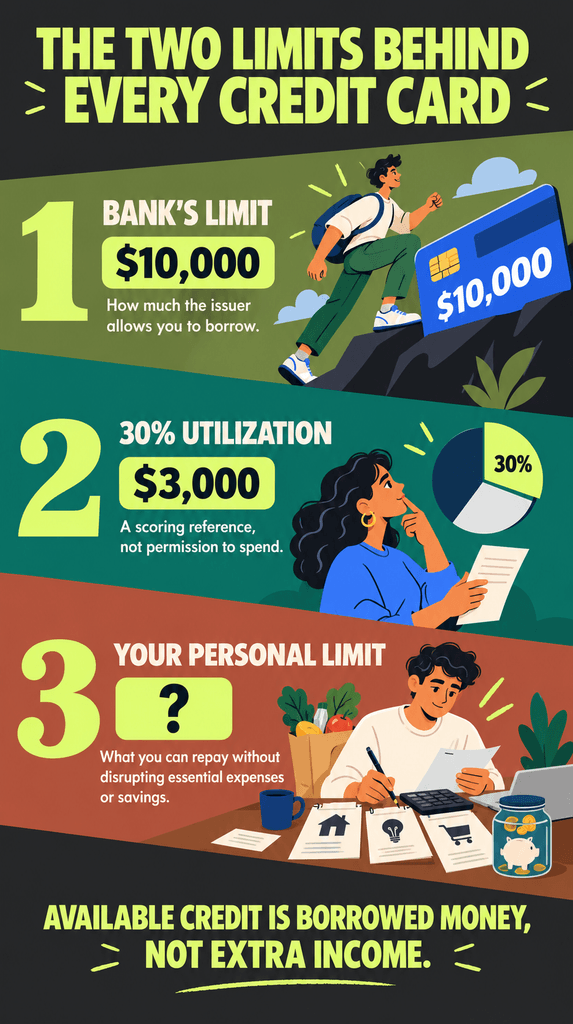
The popular “stay under 30%” advice can also work as an anchor. Once you hear that 30% is acceptable, it can quietly turn into a spending limit. On a card with a $10,000 limit, 30% is $3,000. Someone who would normally feel uneasy owing $2,000 may now see $3,000 as “safe”, simply because it stays inside the range. At that point, a credit score guideline has become psychological permission to borrow.
A higher limit can feel like a raise
A credit limit increase can create the same feeling. If your limit goes from $5,000 to $10,000, you have not received any extra income. Rent, groceries and bills are not easier to pay. Only the amount you can borrow has changed. For that reason, it helps to keep two limits in mind:
- The bank’s limit is the most the card issuer will let you borrow right now.
- Your personal limit is what you can repay without cutting into essentials or savings.
Your personal limit should guide your spending, not the bank’s. Before using the card, ask yourself: would I still buy this if the money left my checking account today?
One card vs. several cards
With one card, the calculation is simple. Notice that it does not use your income at all. Whether you earn $30,000 or $100,000 a year, a $400 balance on a $2,000 limit is still 20%. Income matters when a lender decides whether to give you credit, but it is not part of utilization.
With several cards, however, there are two numbers to watch: the utilization of each card and your overall utilization. To get the overall number, add up the balances, add up the limits and then divide:
| Account | Credit limit | Reported balance | Utilization |
|---|---|---|---|
| Card A | $2,000 | $200 | 10% |
| Card B | $3,000 | $600 | 20% |
| Total | $5,000 | $800 | 16% overall |
Averaging 10% and 20% would give 15%, which is wrong. Card B has the larger limit, so it counts for more.
Even so, a low overall number can hide one card that is nearly maxed out. Imagine a $4,000 card with no balance and a $1,000 card with a $900 balance. Overall, that is only 18%, yet the second card is at 90% of its own limit. FICO explains in its guide to credit utilization that its scores can look at both overall utilization and high balances on individual cards.
What 10%, 30% and 50% look like
Percentages are easier to understand when you turn them into dollars. Here is the same card with a $5,000 limit and no other cards:
| Utilization | Reported balance | Available credit |
|---|---|---|
| 10% | $500 | $4,500 |
| 30% | $1,500 | $3,500 |
| 50% | $2,500 | $2,500 |
The limit stays at $5,000 in every row. Only the reported balance changes.
At 10%, most of the limit is unused. You do not need to leave the $500 unpaid: the bank can report it, and you can still pay the full statement balance by the due date. A balance on your credit report is not the same as debt carried from month to month.
At 30%, you reach the number most people have heard of. However, FICO says its data does not support the idea that your score suddenly drops when you cross the 30% mark. In general, lower is better, but 30% is a rough reference, not a target and not a cliff.
At 50%, half of your limit is in use. That may weigh more on your score, especially if other cards are also high. Still, no one can predict an exact point change, because scores look at your whole credit report. More importantly, ask whether you can repay $2,500 comfortably. If not, the interest and the pressure on your budget matter more than your score.
Which balance actually counts?
A credit card can show several balances at once, and they are not the same:
| Balance | What it means |
|---|---|
| Current balance | What you owe right now, including recent purchases and payments |
| Statement balance | What you owed when your last billing cycle ended |
| Reported balance | What the card issuer last sent to the credit bureaus |
Utilization is based on the reported balance, which may match the statement balance, although that is not guaranteed.
Card issuers often report around the end of each billing cycle, but practices vary. That is why paying in full every month does not always show 0% utilization: the issuer may report your statement balance before you pay it. For example, imagine John spends $1,500 on a $5,000 card, pays $1,000 before the statement closes and the issuer reports the remaining $500. His utilization would show about 10%, and he can still pay the $500 by the due date without paying interest.
Keep the two dates apart: the statement closing date ends the billing cycle, while the due date is your payment deadline. In between is the grace period. As the CFPB explains, paying the full balance by the due date can help you avoid interest on new purchases when your card offers a grace period. You can see how all these numbers appear on a real statement in How to Read a Credit Card Statement.
Check your own utilization
Use the calculator below to see your overall utilization and the utilization of each card. It also warns you when one card is using half or more of its limit, even if your overall number looks fine.
How to use it: enter the credit limit and the current balance of up to three cards. You can find both in your card app or on your statement. If you only have one or two cards, leave the others at 0. The results update as you type.
TRY IT WITH YOUR NUMBERS
Credit utilization calculator
Enter the limit and the balance of up to three cards. Leave a card at 0 if you do not have it.
OVERALL UTILIZATION
–
–
EACH CARD
–
Simplified estimate. Scoring models use the balances and limits on your credit report, which may differ from your banking app. There is no utilization percentage that guarantees a specific score.
Try paying down only the card with the highest percentage and watch how the warning disappears, even when your overall utilization barely moves.
Why utilization can change quickly
Unlike a late payment, high utilization is not permanent. Suppose a card reports a $2,500 balance on a $5,000 limit, which is 50%. If you pay it down to $500, utilization may fall to 10% once the new balance is reported. Many common FICO Scores use the most recently reported balances, so a lower balance can replace the old one in the calculation. Some newer models, however, also look at your balances over time.
The change is not instant, though. First, the payment has to be processed. Then the issuer has to report the new balance, and after that your credit report has to update before a new score is calculated. Meanwhile, paying every bill on time should always come first. Lowering utilization is never worth missing a required payment on another account.
How to lower utilization without playing games
- Pay down the balance. It is the most direct way, and it also cuts future interest. On a $5,000 limit, paying $1,000 off a $2,500 balance moves you from 50% to 30%.
- Pay before the statement closes. If a big purchase pushes your balance up, a payment before the closing date can reduce the amount reported. This can help before an important application, like a mortgage.
- Set a balance alert in dollars. On a $5,000 card, for example, 10% is $500. However, set the alert at what you can repay, not at 30% just because it is a popular number.
- Think twice about a higher limit. It lowers utilization only if your balance stays the same. Ask the issuer whether the request involves a hard inquiry, and be honest about whether more room would tempt you to spend more.
Opening a new card also adds available credit. Still, a new application and a new account affect your credit in other ways and add another bill to manage. A new card should have a real purpose beyond changing one percentage. If you are carrying debt on several cards, a clear repayment plan matters more, as explained in Minimum Payments: Why $90 Feels Right and How a Debt Consolidation Loan Works.
Common myths about credit utilization
- “Under 30%, utilization cannot hurt me.” Actually, 30% is a rough guide, and lower is generally better.
- “I pay in full, so my utilization is 0%.” In fact, the issuer may report your balance before you pay it.
- “I should leave a small balance unpaid.” No. You do not need to carry a balance or pay interest to build credit, and FICO confirms this.
- “Only my overall percentage matters.” On the contrary, one nearly maxed-out card can still count against you.
- “More available credit means I can afford more.” A credit limit measures access to borrowing, not room in your budget.
Next time you look at your available credit, check this
- Read the limit as a loan offer. Available credit is what the bank will lend, not money you have.
- Set your personal limit. Decide what you can repay each month, and let that number guide your spending.
- Check each card, not just the total. Make sure no single card is close to its limit.
- Know your closing date. A payment before it can lower the balance that gets reported.
- Never pay interest to “build credit”. Pay your statement balance in full whenever you can.
ABOUT THE AUTHOR
Lorena founded Money Behaves. She is an economist and a psychology student who focuses on how people make money decisions: how they judge risk, react to percentages and read costs, and what happens when financial information gets complicated. She is not a licensed financial advisor, so every lesson relies on official U.S. sources and published research. See how we write and check our lessons.
Keep learning: What Is Credit and How Does It Work?, How Credit Cards Work and How Credit Card Interest Works.