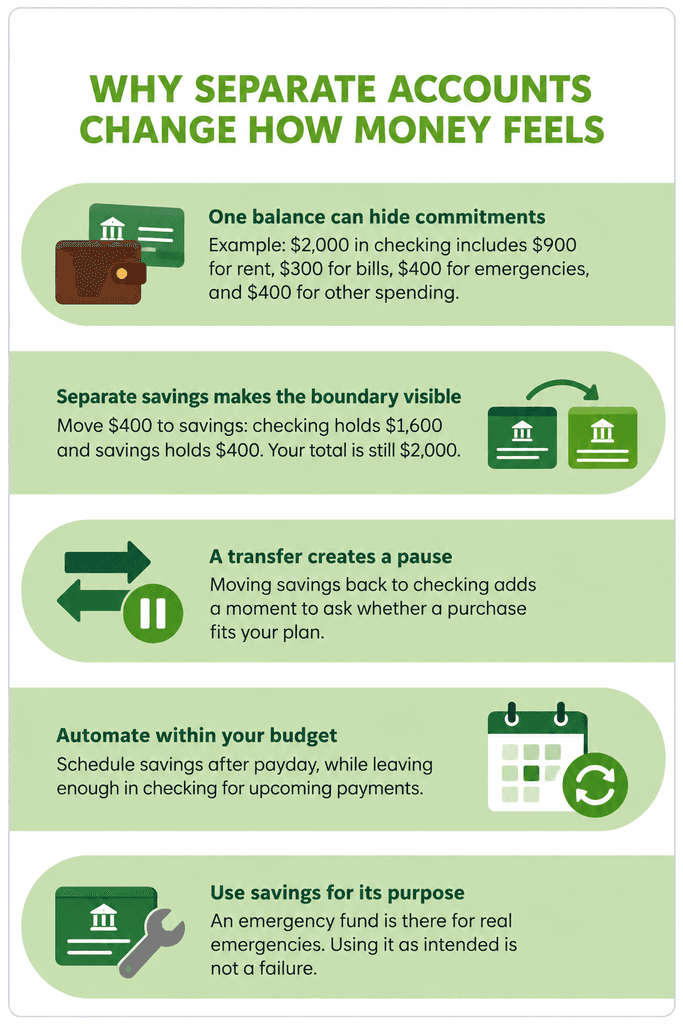
Every month, Lily gets paid, opens her banking app and sees $2,000 in her checking account. At first, it feels like she has money to spare. But $900 is already set aside for rent, $300 is needed for other bills and $400 was supposed to go into her emergency fund. In other words, only about $400 is actually free.
That is also the real difference between checking and savings. Of course, one account usually comes with a debit card and the other pays more interest. More importantly, though, each account gives your money a different job, so the way you split it can change how you see and spend it.
The difference in one view
First, a checking account is built for money that moves through your month: your pay comes in, and bills, card purchases and ATM withdrawals go out. On the other hand, a savings account is built for money with a later purpose, such as an emergency, a move or a yearly bill.
| Feature | Checking account | Savings account |
|---|---|---|
| Main job | Receive pay and make payments | Hold money for future needs |
| Debit card | Common | Varies by bank |
| Bill payments | Usually supported | Often limited |
| Interest | Low or none | Usually higher |
| Best suited to | Monthly cash flow | Emergency and short-term savings |
Common features, so they are not the terms of every account. For example, some checking accounts pay interest, while some savings accounts come with an ATM card.
MONEY TRAPOne balance hides several jobs
“I have $2,000 in my checking account, so I have $2,000 to spend.”
In fact, part of that money may already belong to rent, bills or your emergency fund. So one balance can hide several jobs, which is why separate accounts can change how you spend.
Why one balance can fool you
This is where psychology comes in, because the way money is shown changes how we use it. Economist Richard Thaler, who later won the Nobel Prize, showed in his study Mental Accounting and Consumer Choice that people do not treat all money as the same. Instead, we sort it into mental “accounts” and spend it according to the label we give it.
However, a single checking balance has no labels. As a result, your brain sees one number, $2,000, and treats all of it as available, even though part of it is already promised. When she moves the emergency money into savings, Lily does not earn a single extra dollar. Still, she makes the boundary visible, so the checking balance now shows what she can really spend.
A little friction helps
Separate accounts also add a small pause. Spending from checking needs no extra step, because the debit card is already connected. In contrast, using savings means making a transfer first, which gives you a moment to ask whether the purchase matches what that money was for.
Automation removes the daily decision
Deciding to save at the end of the month is hard, because by then there is often nothing left. Automatic transfers solve this, since they move the decision to payday. Research also supports this: in the famous Save More Tomorrow program, published in the Journal of Political Economy, Richard Thaler and Shlomo Benartzi found that automatic, pre-committed increases helped employees raise their retirement savings rate from about 3.5% to 13.6% over several years. The CFPB also recommends recurring transfers and split direct deposit as easy ways to save automatically.
How a checking account works
Today, for most people, checking is the center of everyday money. For example, suppose Lily takes home $3,200 a month and has these planned costs:
| Monthly cost | Amount |
|---|---|
| Rent | $1,200 |
| Utilities and phone | $250 |
| Groceries | $400 |
| Transportation | $200 |
| Other planned spending | $350 |
| Total | $2,400 |
Hypothetical Money Behaves example, so it is not a recommended budget.
After those costs, Lily has $800 left. Before moving any of it, though, she should remember one thing: the balance on her screen may not all be spendable.
Current balance vs. available balance
Banks often show two numbers. Generally, the current balance reflects transactions that have already posted, while the available balance tries to show what you can use right now after holds and pending charges. However, a scheduled bill or a pending restaurant charge may not appear in either one yet, so always check what is coming before you spend. Otherwise, if a payment goes through without enough money, you could face an overdraft, as explained in What Happens If You Overdraft Your Bank Account.
A debit card is not a credit card
When Lily pays $60 with a debit card, the money comes straight out of her checking account. By contrast, a credit card uses borrowed money that she has to repay later. Although the two cards look similar, they work very differently, as we explain in What Is Credit and How Does It Work?
How a savings account works
A savings account is also a deposit account, so you can add money, move it back to checking and withdraw it under the bank’s rules. Meanwhile, the bank may pay you interest. For example, suppose Lily moves $400 a month to savings: after six months, she will have $2,400 plus any interest. In short, the account does not create the savings; her regular transfers do, while interest adds a smaller amount on top.
What real banks pay
However, how much interest you earn depends a lot on where you keep your savings. For example, standard savings accounts at large banks such as Chase and Bank of America have paid around 0.01% APY in 2026, while the FDIC’s national average was about 0.38%. Meanwhile, several online banks have offered high-yield savings accounts at roughly 3% to 4%. So on $5,000, that is the difference between about 50 cents and $200 a year. Rates change often, so check the bank’s website, and see the full comparison in How APY Works and What Is a High-Yield Savings Account?
Still, a savings account is meant for money you may need soon. Therefore, it is not designed to replace long-term investing, as explained in Saving vs. Investing.
Plan your own split
Next, use the planner below to see how much of your pay could go to savings each month, and how long it would take to build an emergency fund. This matters because, according to the Federal Reserve’s household survey, only about 63% of U.S. adults could cover a surprise $400 expense with cash.
How to use it: enter your monthly take-home pay, your bills and fixed costs, and your usual everyday spending. Then add a small cushion to keep in checking and how many months of costs you want in your emergency fund, for example three. The results then update as you type.
PLAN YOUR SPLIT
Checking and savings planner
In short, find out how much of each month’s pay could move to savings, and how long it would take to build an emergency fund.
TO SAVINGS EACH MONTH
–
–
EMERGENCY FUND GOAL
–
–
–
Simplified plan, so it is not a budget rule. Also, it assumes the same income and costs every month and does not include interest. The cushion is only needed once, so after the first month it can go to savings too.
Then try lowering everyday spending by just $50. You will see that the time to reach your goal drops faster than you might expect, because every dollar goes straight to savings.
What to compare before opening an account
Account names matter less than account terms. In fact, the CFPB’s checklist for opening an account suggests comparing costs, access and services before you choose:
| Question | Why it matters |
|---|---|
| Is there a monthly fee? | A fee can cost more than the interest you earn |
| Can the fee be waived? | Often, but only with direct deposit or a minimum balance |
| Which ATMs are free? | Otherwise, both your bank and the ATM owner may charge you |
| How are overdrafts handled? | Then a payment may be declined, covered or charged a fee |
| How fast are transfers? | Moving money between banks can take a day or more, so plan ahead |
| Is the bank insured? | Look for FDIC or NCUA coverage before you deposit |
Based on the CFPB’s account-opening checklist, which also covers alerts and support.
Also, an account that looks free may only be free if you meet its conditions every month. So if your income is irregular, check whether the requirement is realistic for you.
Can a bank limit savings withdrawals?
Many people still believe there is a federal limit of six withdrawals a month from savings. However, the Federal Reserve removed that limit in 2020. Even so, banks can still set their own limits or charge fees, so always read your account agreement.
Is your money insured?
At an FDIC-insured bank, both checking and savings accounts are covered, generally up to $250,000 per depositor, per bank, for each ownership category. Similarly, credit unions have protection through the NCUA. Also, if you use a financial app, find out which bank actually holds your money, as explained in What Is FDIC Insurance.
Choose a setup that matches your habits
In the end, there is no single right setup. For example, one checking account may be enough for someone who keeps a detailed budget. On the other hand, adding savings helps when money for later keeps getting mixed up with spending money. Several savings “buckets” can give even more clarity, although each one adds another balance to watch.
Finally, remember that savings is meant to be used. Using your emergency fund for a real emergency is not a failure, because that is exactly what it was for. After all, the goal of separate accounts is to make spending deliberate, not to make you feel guilty.
Next time you check your balance, check this
- Read your balance as several jobs. First, subtract upcoming bills before deciding what is free to spend.
- Give future money its own home. Then move savings out of checking so the balance shows what is really available.
- Automate the transfer on payday. That way, saving happens before spending, not after.
- Check what your savings earn. For example, compare your APY with the rates online banks offer.
- Read the fee rules. Finally, make sure you can meet any conditions every month.
ABOUT THE AUTHOR
Lorena founded Money Behaves. She is an economist and a psychology student who focuses on how people make money decisions: how they judge risk, react to percentages and read costs, and what happens when financial information gets complicated. She is not a licensed financial advisor, so every lesson relies on official U.S. sources and published research. See how we write and check our lessons.
Keep learning: How APY Works, What Is a High-Yield Savings Account? and What Is FDIC Insurance.