For example, imagine your checking account shows $45 when a $60 automatic payment arrives. At that moment, your bank has two choices. It can pay the bill and let your account drop below zero, or it can refuse the payment and send it back. Either way, a $15 gap can quickly turn into a much bigger problem.
If the bank pays, you owe the bank, often with a fee on top. By contrast, if it refuses, the company you were paying is still waiting for its money and may charge its own late fee. So in this lesson, we look at what happens in each case, what banks really charge in 2026, which rules protect you and how to stop a small shortage from snowballing.
Three things your bank can do
An overdraft happens when you do not have enough money for a payment and the bank pays it anyway, so your balance becomes negative. However, that is only one of the possible outcomes:
| Outcome | Bank’s action | What it means for you |
|---|---|---|
| Overdraft | Pays the payment | Your balance goes negative, and a fee may apply |
| Returned payment (NSF) | Refuses and sends it back | Meanwhile, the company stays unpaid and may charge its own fee |
| Declined card purchase | Says no at the register | The purchase does not happen, so no overdraft fee arises |
Common outcomes. Every bank and credit union has its own policy, so check your account agreement.
What overdrafts really cost in 2026
First of all, overdraft fees vary a lot from bank to bank. According to the Congressional Research Service, banks that charge them typically ask for around $35 per overdraft. However, some large banks have changed course in recent years:
| Bank | Overdraft policy | When |
|---|---|---|
| Capital One | No overdraft or NSF fees on its checking accounts | Changed in 2021 |
| Bank of America | Overdraft fee cut to $10 | Changed in 2022 |
| Chase | Fee still charged, with a larger buffer and a grace period | Policy updates since 2022 |
| Top 20 U.S. banks | None charge NSF fees for returned payments | NCLC, 2026 |
Policies change, so always confirm the current terms on your bank’s website.
Even so, overdrafts remain big business. The National Consumer Law Center estimated that overdraft and NSF fees cost Americans about $12 billion in 2025, with JPMorgan Chase and Wells Fargo each collecting around $1 billion. Also, the CFPB finalized a federal rule in December 2024 that would have capped most overdraft fees at $5, but Congress overturned it in 2025, so it never took effect.
How a $15 gap becomes $45
Let us go back to the first example. Suppose Luca has $45, and a $60 automatic payment arrives. If the bank pays it, his balance becomes $45 − $60 = −$15. Then imagine his bank charges a $30 overdraft fee, so the balance falls to −$45.
As a result, Luca now needs $45 just to get back to zero. Even worse, if another payment arrives before his paycheck, it may trigger a second fee. In short, that is how one small shortage can turn into several charges in a single week. On the other hand, if the bank returns the payment, Luca avoids the negative balance, but the company may charge a late fee and try to collect again a few days later.
MONEY TRAP
The number on the screen is not your spending money
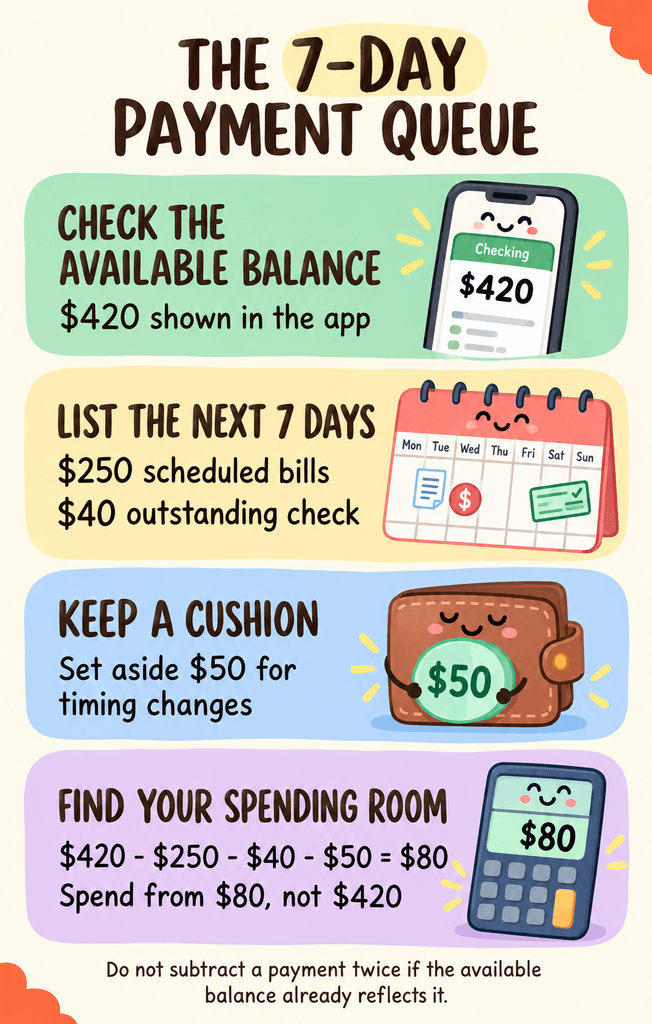
At first, your app shows one big number, the available balance, and our brains treat it as money we can spend. However, that number does not know about the rent payment scheduled for tomorrow, the check you wrote last week or the subscription that renews on Friday.
Attention also plays a big part. In a study in the Review of Financial Studies, Limited and Varying Consumer Attention, economists Victor Stango and Jonathan Zinman found that people were less likely to overdraft right after answering survey questions about overdraft fees. Yet the effect faded within a few months, as their attention moved elsewhere.
In other words, knowing about overdrafts is not enough. What protects you is a system that keeps upcoming payments in view, such as alerts, a cushion and a quick look at the next seven days.
The opt-in rule for debit cards and ATMs
Fortunately, federal law gives you one important choice. Under Regulation E, a bank generally cannot charge an overdraft fee on ATM withdrawals and one-time debit card purchases unless you have opted in. So if you have not opted in and do not have enough money, those transactions are usually just declined, with no fee.
However, this protection is narrower than many people think. In particular, it does not cover checks, automatic bill payments, recurring debit card charges such as subscriptions, or electronic ACH withdrawals. Instead, your bank can still pay or return them under its regular policy. The CFPB explains your overdraft options in more detail, and you can change your choice at any time by contacting your bank.
Map your next 10 days
In fact, most overdrafts are a timing problem, not a spending problem. So use the timeline below to see what your balance will do over the next ten days, once your bills and your paycheck arrive.
How to use it: enter your available balance, your next paycheck and the day it arrives. Then add your upcoming payments and the day each one will post, plus your bank’s overdraft fee. As a result, the line shows every day your balance would drop below zero, and the summary tells you how much to move to stay safe.
Then try moving the paycheck one day earlier, or one bill a few days later. You will see that small changes in timing can remove every fee, which is why a quick weekly look at upcoming payments works so well.
What to do as soon as you notice an overdraft
- Stop optional spending from the account. First, pause anything that can wait, and look at what is coming up in the next few days.
- Ask the bank what happened. For example, find out which payment caused it, whether the bank paid it or sent it back, and which fees have posted.
- Bring the balance back above zero. Then move money from savings or wait for your paycheck, and plan for the next payments too.
- Contact the company you were paying. If the bank returned a payment, the bill is still unpaid, so ask whether they will try again.
- Ask for a refund of the fee. Banks often waive a first fee, especially for long-time customers, so it is always worth a polite call.
What happens if the balance stays negative
Usually, a short overdraft fixed quickly causes no lasting harm. However, a balance left negative for weeks is different. For example, the bank may use your next deposit to cover what you owe, block your card, close the account or send the debt to a collection agency.
Importantly, ordinary checking activity does not appear on your credit report. Still, as the CFPB explains, an account closed with an unpaid balance can appear in specialty reports such as ChexSystems, which banks use to decide whether to open new accounts. And if the debt goes to collections, the collector may report it to the credit bureaus, which can affect your score, as we explain in Credit Score Explained.
How to prevent overdrafts
- Keep a small cushion. For example, treat the first $50 or $100 in checking as untouchable.
- Set low-balance alerts. Also, most banking apps can text you when your balance drops below an amount you choose.
- Line up bills with paydays. In fact, many companies let you change your due date, so payments arrive after your income.
- Link a savings account. Then some banks move money automatically from savings to cover a shortage, often for free or a small fee.
- Consider a bank with no overdraft fees. After all, as shown above, several large banks no longer charge them at all.
Similarly, keeping your emergency fund in a separate account helps, as long as you can reach it quickly when you need it. We explain how to set this up in Checking vs. Savings Accounts and What Is a High-Yield Savings Account?
Common questions
Is an overdraft the same as a loan?
In practice, it works like a very short, very expensive loan. For example, a $35 fee to cover a $20 shortage for a few days would be an enormous interest rate if you expressed it as an APR.
Should I opt in to overdraft coverage for my debit card?
It depends on what you prefer. If you opt in, a purchase may go through, but it can cost a fee. On the other hand, if you stay opted out, the card is usually just declined at the register, which is inconvenient but free.
Can a bank charge several overdraft fees in one day?
Yes, many banks can, although they often set a daily maximum, such as three fees. Therefore, check your account agreement for the daily limit and for any grace period to bring your balance back.
ABOUT THE AUTHOR
Lorena founded Money Behaves. She is an economist and a psychology student who focuses on how people make money decisions: how they judge risk, react to percentages and read costs, and what happens when financial information gets complicated. She is not a licensed financial advisor, so every lesson relies on official U.S. sources and published research. See how we write and check our lessons.
BANKING & SAVING COURSE · COMPLETE
Your banking basics are in place.
Now you know how to keep spending money, savings and deposit insurance working together. So the natural next step is to make your money grow: