BANKING & SAVING · LEVEL 2
Before you start: this lesson builds on What Is FDIC Insurance? from Level 1. It assumes you already know which products are covered and why the limit applies per bank. Here, you will learn how to calculate FDIC insurance across all your accounts, and what to do in the cases where the basic rule is not enough.
For example, imagine Caroline has checking, savings and a certificate of deposit at the same bank, a joint account with her partner, and some money in a savings app that names a partner bank. In her banking app, therefore, these look like five separate pots. However, the FDIC does not count them as five separate amounts of insurance.
Instead, coverage depends on three things: who legally owns the money, which insured bank holds it and which ownership category it falls into. For most people, this never matters, because their total deposits are far below $250,000. Still, it becomes important when you receive a large sum, such as a home sale, an inheritance or a business payment, or when your savings grow over the years.
So in this lesson, we work through Caroline’s case step by step, give you an interactive coverage map for your own accounts and explain what happens to money that ends up above the limit.
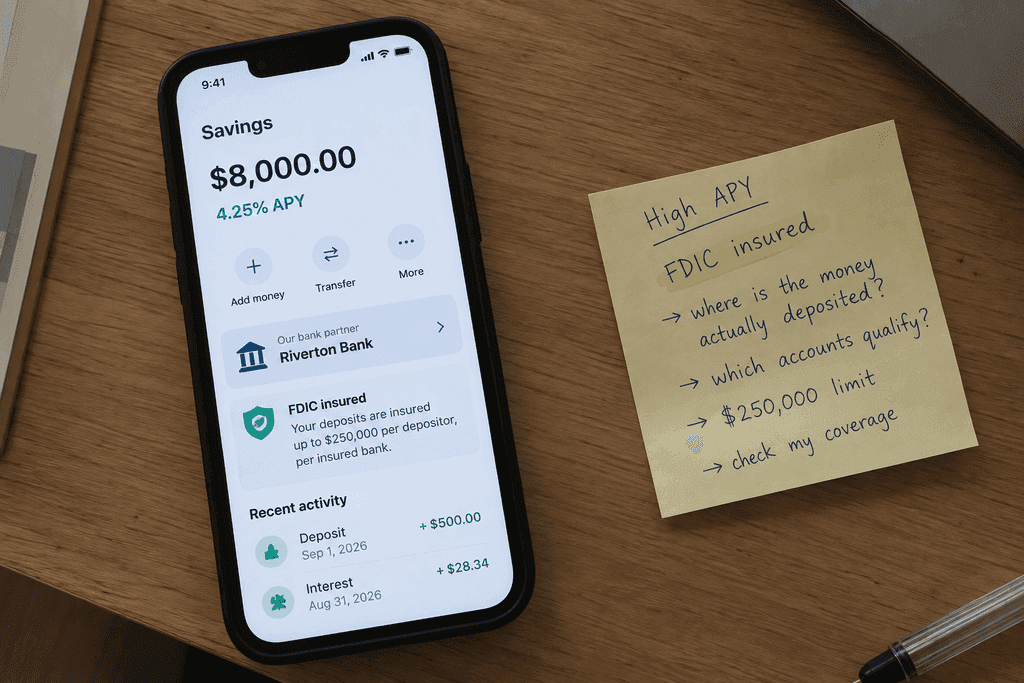
The rule, and the three questions behind it
First of all, according to the FDIC, the standard insurance amount is $250,000 per depositor, per insured bank, for each account ownership category. So before you add up any balances, answer three questions:
- Who legally owns the money? In other words, whose name is on the account, not who uses it.
- Which insured bank actually holds it? In particular, that means the legal bank, not the app or the brand name.
- Which ownership category applies? For example, single, joint, certain retirement accounts or trust accounts.
The order matters. Two accounts with different names, such as “Emergency Fund” and “Vacation”, may still fall in the same group. Conversely, the FDIC can insure two deposits at the same bank separately if they belong to different categories.
Step 1: build a coverage map
In short, a coverage map is simply a list of your accounts organized by bank and category. It works better than counting accounts, because it shows which balances the FDIC adds together. Here is Caroline’s map:
| Account in her app | Legal bank | Owner | Category | Balance |
|---|---|---|---|---|
| Everyday checking | Bank A | Caroline | Single | $40,000 |
| Emergency savings | Bank A | Caroline | Single | $180,000 |
| 12-month CD | Bank A | Caroline | Single | $70,000 |
| Household savings | Bank A | Caroline and Jordan | Joint | $200,000 |
| Online savings | Bank B | Caroline | Single | $60,000 |
Hypothetical Money Behaves example.
The names in the first column only describe how Caroline uses the money. However, they do not create insurance categories. Her checking, emergency savings and CD all belong to her alone, at the same bank, so they share one limit.
Step 2: add up each group
First, at Bank A, Caroline’s three single-owner accounts add up to $40,000 + $180,000 + $70,000 = $290,000. So under the standard limit, the FDIC insures $250,000, while $40,000 is above the limit. In other words, splitting the money into checking, savings and a CD does not create three limits, and opening a fourth account would not help either.
Also, keep interest in mind when you are close to the limit. That is because the FDIC counts both the principal and the interest earned up to the day a bank fails. For example, a $249,000 CD paying 4% would cross the limit within about two months.
Step 3: treat each bank separately
Caroline’s $60,000 at Bank B is a separate calculation, because Bank B is a different insured bank. So her single-owner position looks like this:
| Bank | Single-owner deposits | Insured | Above the limit |
|---|---|---|---|
| Bank A | $290,000 | $250,000 | $40,000 |
| Bank B | $60,000 | All of it | None |
Simplified example, so it assumes each bank has a separate charter.
Therefore, moving $40,000 from Bank A to Bank B would bring both totals within the limit. However, be careful with brand names. Some banks run several online brands under one charter, so two names can still be one bank. Fortunately, you can check the legal name with the FDIC’s BankFind tool.
MONEY TRAP
More accounts feel like more protection
At first, splitting money into several accounts feels safer. Each one has its own name, color and balance in the app, so it looks like a separate pot with its own protection. Yet at the same bank, in the same ownership category, they all share one $250,000 limit.
In fact, this is a close cousin of what economists call naive diversification. For example, in a study in the American Economic Review, Naive Diversification Strategies, Shlomo Benartzi and Richard Thaler found that people tend to spread money evenly across whatever options they see, as if splitting alone reduced risk. Similarly, more accounts can feel like more safety even when nothing has changed.
In short, labels and tiles in an app do not create coverage. Instead, owners, banks and categories do.
Step 4: check the other categories
Different ownership categories can add separate coverage at the same bank, as long as the accounts meet the FDIC’s requirements. For example, here are the four most common ones:
| Category | How coverage works | Caroline’s case |
|---|---|---|
| Single accounts | Up to $250,000 per owner, per bank | $290,000 at Bank A, so $40,000 is above the limit |
| Joint accounts | The FDIC insures each co-owner’s share up to $250,000 | $200,000 shared equally, so the FDIC covers all of it |
| Certain retirement accounts, such as IRAs | Also up to $250,000 per owner, separate from other categories | None in this example |
| Trust accounts | Up to $250,000 per eligible beneficiary, with a maximum of $1.25 million per owner at each bank | None in this example |
Summary of the FDIC’s rules, including the trust rules that took effect in April 2024, although each category has detailed requirements.
For instance, Caroline and Jordan each own half of their $200,000 joint account, so each share is $100,000. Since both shares are below $250,000, the FDIC insures the whole account. Meanwhile, the trust rules changed in 2024: as the FDIC explains in its guide to insured deposits, revocable and irrevocable trust deposits now share one calculation, up to $250,000 for each eligible beneficiary and up to five beneficiaries per owner.
Here is how that rule works with numbers. Suppose Jordan opens a living trust account at Bank A that names his three children as beneficiaries. In that case, the trust deposits can be covered up to 3 × $250,000 = $750,000. If he named seven beneficiaries instead, the rule would still count only five, so the maximum at that bank would be $1.25 million.
A word of caution before adding owners
Still, adding a co-owner or a trust only to raise coverage is a serious decision. It can change who controls the money, what happens when someone dies and even your taxes. So for large sums, talk to a legal or tax professional first. Also, note that the FDIC only covers an IRA when it holds bank deposits, such as a savings account or CD, not investments like stocks or funds, as we explain in 401(k), IRA and Brokerage Accounts.
If you run a business or work freelance
Business money follows its own rules, and the legal form of the business decides which ones apply. A corporation, an LLC or a partnership gets its own $250,000 at each bank, separate from the owners’ personal accounts. However, the business must be a real, independent activity, not an account opened only to gain extra coverage. Also, adding more owners or signers does not raise that limit.
A sole proprietorship works differently, and this catches many freelancers off guard. According to the FDIC’s guide to insured deposits, it counts as a single account of the owner. So if Caroline worked as a freelance designer and kept $50,000 in a business account under her own name at Bank A, that money would join her $290,000 in personal single accounts there. As a result, her amount above the limit would grow from $40,000 to $90,000.
Map your own deposits
Next, use the coverage map below to group your own accounts the way the FDIC does. In short, it shows each group, how much appears insured and how much may be above the limit.
How to use it: for each account, choose the bank and the ownership category, and then enter the balance. In the last column, enter the number of owners for joint accounts, or the number of beneficiaries for trust accounts. The example already shows Caroline’s accounts, so you can start by changing her numbers, and the table updates as you type.
Step 5: investigate any app separately
An app can look like a bank even when the company behind it is not one. Instead, it may place your money at one or more partner banks. In that case, your deposits may qualify for pass-through insurance, but only if the arrangement meets the FDIC’s rules. As we saw in Level 1, that insurance protects you if the partner bank fails, not if the app company does. For the calculation, though, a different detail matters more.
For instance, if an app places Caroline’s $60,000 at Bank B, where she already has money directly, the FDIC may add both balances together. So before you include an app in your map, find the legal name of the partner bank, check whether the terms describe pass-through coverage, and see whether you already hold money at that same bank.
Step 6: confirm with official tools
First, confirm each bank’s legal name and insured status in BankFind. Then enter your accounts, one bank at a time, into the FDIC’s Electronic Deposit Insurance Estimator (EDIE), which applies the official rules and shows any amount above the limit. Finally, for a credit union, use the NCUA’s share insurance tools instead, since the FDIC does not insure credit unions.
Afterward, repeat the check whenever something big changes, such as a large deposit, a new co-owner or a new app. After all, coverage depends on how you set up your accounts today, not on how they looked when you opened them.
Common calculation mistakes
- Counting accounts instead of categories. In fact, three single-owner accounts at one bank usually share one limit.
- Treating branches as different banks. In reality, every branch belongs to the same bank, so moving money between them does not help.
- Trusting brand names. Two brands can share one charter, so always check the legal bank.
- Forgetting interest. For example, a balance just under the limit can cross it as interest builds up.
- Counting app balances separately. Otherwise, money you place through an app may join your direct deposits at the same partner bank.
What really happens to money above the limit
Insured money is usually back in depositors’ hands within days. In contrast, money above the limit follows a slower and less certain path.
When a bank fails, the FDIC takes control of what is left of it as the receiver. Uninsured depositors then receive a receivership certificate, which is simply a claim on the bank’s remaining assets. Next, as the FDIC sells the bank’s loans, buildings and other assets, it pays those claims in stages, called dividends. Since 1993, federal law has placed depositors ahead of most other creditors in that line. That helps, but it does not guarantee full repayment.
Real cases show how wide the range of outcomes can be:
- IndyMac (2008). When this California bank failed, the FDIC paid uninsured depositors an advance dividend of 50% of their uninsured amount. Any further payments depended on what the remaining assets raised later.
- Silicon Valley Bank and Signature Bank (2023). Regulators used a rare emergency exception and protected every deposit, including the amounts above the limit.
- First Republic Bank (2023). JPMorgan Chase bought the failed bank and took over all of its deposits, so customers kept access to their money.
The last two cases explain why so many people believe large deposits are always rescued. Yet those were decisions made under pressure, not rules. The safer assumption is still the standard one: anything above the limit could take months to recover, and part of it may never come back.
Two events that can change your coverage
Your coverage can shift even when you do not touch your accounts. In particular, two situations catch people by surprise.
When an account owner dies
The FDIC keeps insuring a deceased person’s accounts as if they were still alive for six months. This grace period gives the family time to reorganize the money. After that, the accounts are counted under the new owners, which can push a surviving spouse or an heir over the limit at a bank where they already keep money. By contrast, if a beneficiary of a trust account dies, there is no grace period, so coverage can drop right away.
When two banks merge
If your bank merges with another bank where you also have money, the two become one bank for insurance purposes. To soften the change, the FDIC keeps deposits from the acquired bank separately insured for six months. CDs keep separate coverage until their first maturity date after those six months, as long as they renew on the same terms. So whenever a merger letter arrives, it is a good moment to rebuild your coverage map.
How people keep large balances fully covered
When a balance goes over the limit, there are several common ways to bring it back under. The names below are examples to help you understand the options, not recommendations, and each one comes with its own costs and trade-offs.
- Spread the money across separate banks. This is the simplest route. Each legally separate bank adds a new $250,000 per ownership category, provided you check its charter in BankFind first.
- Use a deposit placement network. Some banks offer services such as IntraFi’s ICS and CDARS, which split a large deposit across many banks in a network. You deal with one bank, while each piece stays under the limit at a different bank.
- Buy brokered CDs. Through a brokerage account, you can buy CDs issued by different banks, and each bank’s CD is generally insured separately. Keep in mind, though, that selling one before it matures can mean getting back less than you paid.
- Keep part of the cash outside the banking system. U.S. Treasury bills are backed by the federal government rather than by the FDIC. Because they are not deposits, they work differently, yet many people use them for money they will not need soon.
Whichever route you choose, the final habit is the same: update your coverage map, and then confirm the result with EDIE.
Common questions
Do I need to worry if I have less than $250,000 in total?
Usually not, as long as your money sits at FDIC-insured banks in eligible deposit accounts. The calculation mainly matters when your total deposits at one bank approach the limit.
Does each family member get their own $250,000?
Yes, but only for accounts they own. For example, the FDIC insures a single account in each spouse’s name separately, and a joint account between them is a separate category again. However, the ownership must be genuine, not just a label.
ABOUT THE AUTHOR
Lorena founded Money Behaves. She is an economist and a psychology student who focuses on how people make money decisions: how they judge risk, react to percentages and read costs, and what happens when financial information gets complicated. She is not a licensed financial advisor, so every lesson relies on official U.S. sources and published research. See how we write and check our lessons.