BANKING & SAVING · LEVEL 1 · LESSON 2
MONEY TRAPThe word “insured”
“The app says FDIC insured, so my money is protected no matter what.”
FDIC insurance protects eligible deposits if an insured bank fails, up to the limit. It does not cover investments, fraud or the failure of a company that is not a bank.
In this lesson: what FDIC insurance covers and what it does not, the basic $250,000 rule, what real bank and app failures teach us and how to check that your bank is insured.
You deposit your paycheck, open your banking app and see the money sitting in your account. At that moment, it feels secure. But what would happen if the bank itself failed?
That is exactly the problem FDIC insurance is designed to solve. Imagine Chloe keeps $4,000 in checking and $12,000 in savings at the same bank. If the bank is FDIC-insured and both accounts qualify, her $16,000 is protected. However, FDIC insurance does not protect every financial product or every way money can be lost, so it is worth knowing exactly what it does.
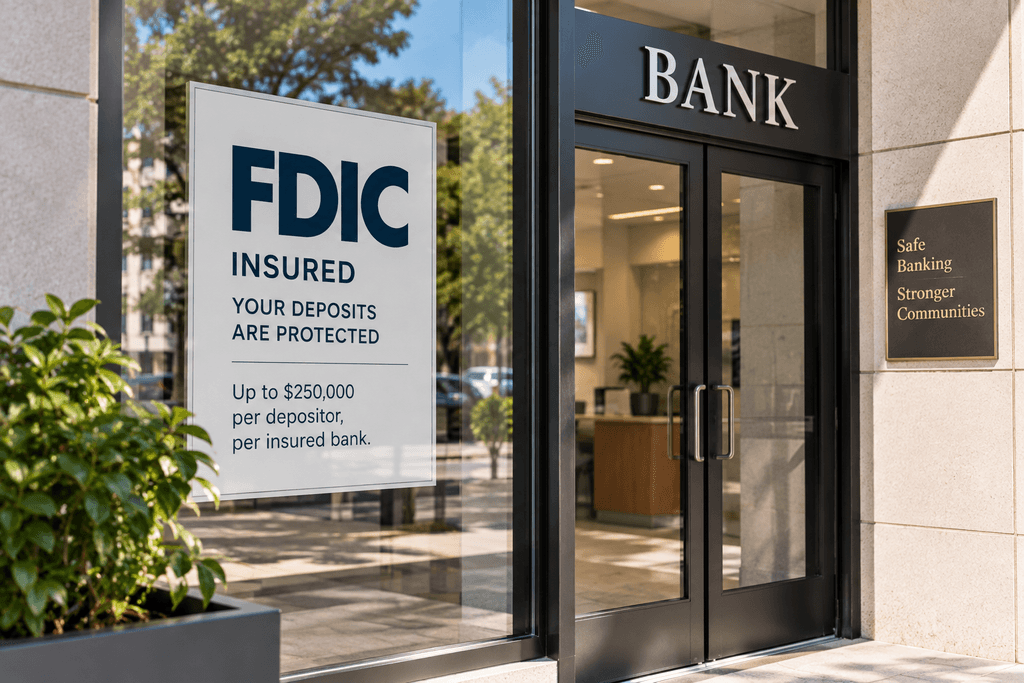
What FDIC insurance protects
The Federal Deposit Insurance Corporation, or FDIC, is an independent agency of the U.S. government. It was created in 1933, after thousands of banks failed during the Great Depression and many families lost their savings. Today, its standard coverage rule is:
Up to $250,000 per depositor, per insured bank, for each account ownership category.
Coverage is automatic for eligible deposits. In other words, you do not apply, buy a policy or pay the FDIC anything. According to the FDIC, no depositor has lost a single penny of FDIC-insured funds since it began operating in 1934. Even so, one limit is key: it protects deposits if an insured bank fails. It is not general insurance against every way money can be lost.
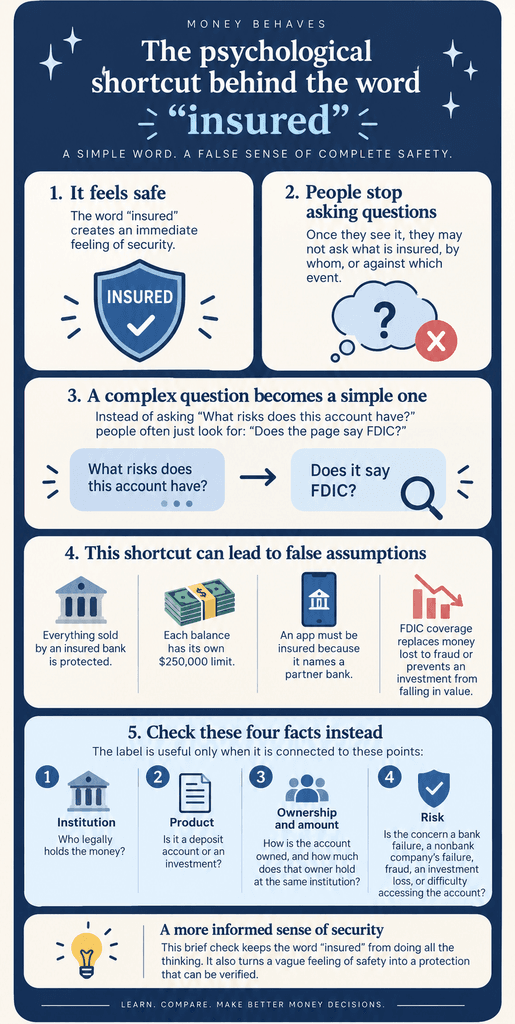
Why the word “insured” can stop us from asking questions
“Insured” is a reassuring word, so as soon as we see it, many of us stop asking the follow-up questions: what exactly is insured, by whom and against what? Psychologists call this a mental shortcut. A hard question, such as “what risks does this account have?”, gets swapped for an easier one: “does the page say FDIC?”
That shortcut can lead to several false beliefs. For example, people may assume that everything sold by an insured bank is protected, that each account has its own $250,000, or that an app must be insured because it mentions a partner bank. Real events show why these details matter.
A real example: when the app is not the bank
In April 2024, a company called Synapse Financial Technologies filed for bankruptcy. However, Synapse was not a bank. Instead, it sat between popular savings and banking apps, such as Yotta and Juno, and the real banks that held the money, including Evolve Bank & Trust. Many customers had been told their money was FDIC-insured. Yet after the collapse, a court-appointed trustee found that up to $96 million of customer funds was missing, and the FDIC made clear that its insurance does not cover the failure of a nonbank company.
The lesson is not that every app is dangerous. Rather, the label “FDIC insured” only protects you against one specific event: the failure of the insured bank holding your money. It does not protect you if the company in the middle loses track of who owns what.
A real example: when deposits are over the limit
In March 2023, Silicon Valley Bank failed, one of the largest bank failures in U.S. history. Most of its customers were businesses with balances far above $250,000, so a large share of its deposits was uninsured. In that case, regulators used a special emergency exception to protect all depositors, as announced in a joint statement by the Treasury, the Federal Reserve and the FDIC. However, that was an exceptional decision, not a promise. The standard rule is still $250,000 per depositor, per bank, per ownership category.
A simple habit keeps the word “insured” from doing all the thinking. Before you trust any account, ask four questions: who legally holds the money, what kind of product it is, how it is owned and how much you have there, and which risk you are worried about.
What happens when an insured bank fails
When you deposit money, the bank does not keep your exact dollars in a box. Instead, it uses deposits to make loans and run its business, while keeping enough cash for withdrawals. Occasionally, a bank can no longer meet its obligations, and regulators close it.
After that, the FDIC steps in and works out each customer’s insured deposits from the bank’s records. As the FDIC explains in its deposit insurance guide, it usually moves insured accounts to another bank or pays depositors directly, often within a few days. For Chloe, the records would show $4,000 in checking and $12,000 in savings, so her $16,000 total is well below the limit.
Which accounts are covered
FDIC insurance covers deposit products at an FDIC-insured bank. The table below summarizes the FDIC’s official list of insured financial products:
| Product | Covered at an insured bank? |
|---|---|
| Checking account | Yes |
| Savings account | Yes |
| Money market deposit account | Yes |
| Certificate of deposit (CD) | Yes |
| Cashier’s checks and other official bank items | Generally yes |
| Stocks, bonds, mutual funds and ETFs | No |
| Annuities and life insurance | No |
| Cryptocurrency | No |
| Safe deposit box contents | No |
Source: FDIC. Investments are not covered, even when you buy them through an insured bank.
Watch out for similar names. A money market deposit account at an insured bank can be covered, whereas a money market mutual fund is an investment and is not FDIC-insured. Likewise, if Chloe invests $5,000 in a stock fund through her bank and it falls to $4,000, the FDIC does not replace that $1,000 loss. To understand what you actually own when you invest, read Stocks, Bonds, Mutual Funds and ETFs.
Similarly, FDIC insurance does not cover scams, identity theft or unauthorized transactions. If someone steals your debit card details, the bank has not failed, so different rules and deadlines apply.
The $250,000 rule in plain words
The standard limit sounds simple, yet it has three parts. Coverage is counted per person, per bank and per type of ownership, such as an account in your name only or a joint account you share with a partner.
In practice, opening several accounts at the same bank does not multiply your protection. Your checking, savings and CDs there, all in your own name, are added together and share one $250,000 limit. By contrast, money at a second, legally separate bank has a limit of its own.
For most people, that is all they need to know. Chloe’s $16,000, for example, sits far below the limit, so every dollar is covered. Many households never come close to $250,000 at a single bank.
The details only start to matter when a large sum arrives, such as money from a home sale, an inheritance or a business. If that ever happens to you, continue with How to Calculate FDIC Insurance, a Level 2 lesson that works through joint, trust and business accounts with real numbers.
How to check that your bank is FDIC-insured
A logo on a website is easy to copy, so it is worth checking the official source instead. The whole process takes about two minutes:
- Find the bank’s legal name. You can usually see it at the bottom of the bank’s website or on your account statement. It often looks slightly different from the brand name in the ads.
- Search for it in BankFind. Type that name into the FDIC’s BankFind tool. An insured bank appears with its FDIC certificate number and its main address.
- Compare the details. Make sure the address and website match the bank you actually use. Scam sites sometimes borrow the name of a real bank.
- Look for the official sign. Insured banks display the “Member FDIC” sign in their branches and on their websites, although the search in step 2 is what really confirms it.
If the bank does not appear in BankFind, hold off on depositing money there until you understand why. It may simply be a credit union, which uses a different insurer. On the other hand, it may not be a bank at all.
Banks, credit unions and financial apps
FDIC insurance applies to banks and savings associations, not credit unions. Federally insured credit unions are protected in a similar way by the NCUA, generally up to $250,000 as well. So look for “Member FDIC” at a bank and the NCUA notice at a credit union, and then confirm it through the official search tools rather than trusting a logo.
Financial apps need an extra check, because many popular apps are not banks: they partner with one or more banks that hold the money. For example, Chime’s website states that its banking services are provided by partner banks that are FDIC members. In these setups, your money can qualify for pass-through insurance, but only if the arrangement meets the FDIC’s requirements and the bank’s records show what belongs to you. As the FDIC explains in its guide on banking with third-party apps, deposit insurance does not protect you if the app company itself fails.
Before you keep a large amount of savings in an app, find out:
- Whether the company is a bank or a nonbank business
- Which bank actually holds your money, and whether it is FDIC-insured
- Whether other money you keep at that same bank counts toward the same limit
- What would happen to your money if the app company stopped operating
If you are choosing where to keep your savings, see What Is a High-Yield Savings Account? and How APY Works. And when you are deciding between keeping money in the bank and investing it, read Saving vs. Investing.
Next time you see “FDIC insured”, check this
- Confirm the bank is insured. Look it up in the FDIC’s BankFind tool, not just the logo.
- Check the product. Deposits are covered, while investments, crypto and safe deposit boxes are not.
- Remember the basic limit. Up to $250,000 per person, per bank, per type of ownership. Getting close to it? Then work through the full calculation.
- Ask who holds the money in an app. Insurance covers the bank’s failure, not the app company’s.
- Name the risk. Bank failure, fraud, an investment loss and an app shutdown are covered by different rules.
ABOUT THE AUTHOR
Lorena founded Money Behaves. She is an economist and a psychology student who focuses on how people make money decisions: how they judge risk, react to percentages and read costs, and what happens when financial information gets complicated. She is not a licensed financial advisor, so every lesson relies on official U.S. sources and published research. See how we write and check our lessons.
WHERE TO GO FROM HERE
Next in Level 1: How APY Works, to see how the money in your insured account actually grows.
Have several accounts, or more than $250,000 at one bank? Jump ahead to How to Calculate FDIC Insurance in Level 2.