Hannah expects to retire around 2060. When she opens her workplace retirement plan, one option seems made for her: a fund with “2060” in its name. At first, the decision looks finished. She simply picks the year, contributes every paycheck and lets the fund do the rest.
That is the basic idea, and for many people it works well. However, the date is only the starting point. Two funds labeled 2060 can hold different investments, reduce risk at different speeds and charge very different fees. So in this lesson, we look at what a target-date fund actually does, test a glide path against 20 real years of market data and show what to check before you choose one.
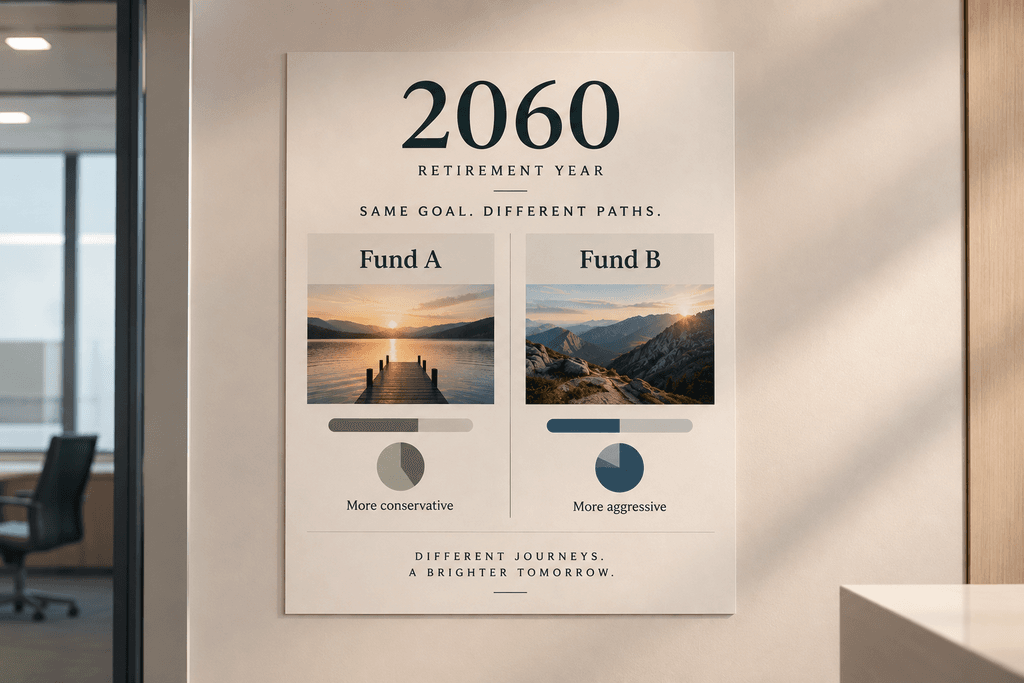
What the date in the name means
In short, a target-date fund is a diversified fund built around an approximate future year, usually the year you expect to retire. According to Investor.gov’s bulletin on target-date funds, these funds generally hold a mix of stocks, bonds and other investments, and that mix becomes more conservative as the target date approaches.
However, the year is not a maturity date. A 2060 fund does not turn into cash in 2060, guarantee a balance or promise enough income for retirement. Instead, it is simply the point around which the fund plans its changes. So choosing the closest year is a reasonable first filter, but not the whole decision.
Three jobs the fund does for you
Typically, most target-date funds are “funds of funds”: instead of buying stocks and bonds directly, they hold several other funds, such as a U.S. stock index fund, an international stock fund and a bond fund. Then the fund takes care of three tasks for you:
- It sets an asset allocation. In other words, it decides how much goes to stocks, bonds and other investments.
- It rebalances. For example, if stocks rise and push the mix to 85% when the plan says 80%, the fund sells some stocks and buys bonds to restore the target.
- It follows a glide path. Finally, over time, it slowly lowers the share of stocks, so an 80% target today might become 60% later and less after retirement.
Rebalancing and the glide path are different things. In short, the first restores the mix the fund aims for today, while the glide path changes that intended mix as the years pass. Together, however, they replace many decisions Hannah would otherwise have to make herself.
A glide path in real numbers
For example, here is a simplified glide path, created by Money Behaves for illustration. It does not represent a specific fund:
| Time to target date | Stocks | Bonds and short-term investments |
|---|---|---|
| More than 30 years | 90% | 10% |
| About 15 years | 75% | 25% |
| At the target date | 50% | Half, so 50% |
| 10 years after | 35% | 65% |
Hypothetical example. Real funds use their own glide paths, so always check the fund’s documents.
In practice, the exact numbers vary a lot. One 2060 fund might start at 90% stocks, while another starts at 85% and moves faster. As a result, the label alone cannot tell you how much risk you are taking.
Test a glide path with 20 real years
But does lowering stocks over time really protect you? To find out, the chart below compares two investors who both retired in 2025. One kept 100% in stocks. Meanwhile, the other followed a target-date style glide path, using the real yearly returns of U.S. stocks and bonds from 2006 to 2025.
How to use it: enter a monthly contribution, then choose how much the glide path holds in stocks at the start and at retirement. As a result, the chart and the three boxes show the worst year for each approach and what happened in 2022.
The results are honest about both sides. First, the glide path cut the damage of 2008 noticeably. On the other hand, it ended with less money, because it held fewer stocks during a strong decade. And in 2022, close to retirement, it still fell sharply, since bonds and stocks dropped at the same time. In short, a glide path reduces risk, but it does not remove it.
“To” or “through” retirement
Glide paths come in two main designs. First, a “to” retirement fund reaches its most conservative mix at or near the target year and then stays there. A “through” retirement fund, by contrast, keeps reducing stocks for years after the target date, so it usually holds more stocks at retirement.
Of course, neither design is automatically better. As the Department of Labor’s guidance explains, funds with the same target date can carry very different risks because of this choice. For example, if Hannah plans to keep most of her money invested for 20 more years after retiring, a “through” design may fit her better.
MONEY TRAP
A year on the label feels like a promise
At first, a fund called “2060” sounds like a plan that will be ready on time, much like a ticket with a departure date. In reality, the year is only the moment around which the fund changes its mix. It is not a guaranteed amount, and it says nothing about whether you are saving enough.
Defaults also carry a quiet message. In a peer-reviewed study in the Journal of Pension Economics and Finance, Target-Date Funds and Portfolio Choice in 401(k) Plans, Olivia Mitchell and Stephen Utkus found that when plans made target-date funds the default, many employees simply kept them. That can be helpful, yet it also means many people never check what the fund holds.
So replace the comforting label with three concrete questions: what is this fund doing with my money today, how will that change, and which part of my plan can it not solve?
Fees: why the same year can cost very different amounts
In addition, target-date funds can be very cheap or surprisingly expensive. For example, index-based series such as Vanguard Target Retirement charge around 0.08% a year, and Fidelity’s Freedom Index series around 0.12%. Meanwhile, actively managed series can charge 0.60% or more. However, fees change, so always check the fund’s current prospectus.
| Expense ratio | Yearly cost on $50,000 | Cost over 30 years on a growing balance |
|---|---|---|
| 0.08% | $40 | Roughly a few thousand dollars |
| 0.60% | $300 | Often tens of thousands of dollars |
Simplified illustration. The 30-year column depends on contributions and returns, as shown in our expense ratio lesson.
Since these funds hold other funds, look for the total annual operating expenses in the prospectus fee table, which already includes the costs of the funds inside. We show how small percentages grow into large amounts in Expense Ratios Explained.
One fund is usually enough
Fund companies design a target-date fund to be your whole retirement portfolio, or at least its core. Therefore, adding other funds on top can quietly change the risk. For instance, suppose Hannah holds $80,000 in a fund that is 80% stocks, plus $20,000 in a separate stock fund. Altogether, she now has about 84% in stocks, not the 80% she chose.
Similarly, the fund cannot see Hannah’s IRA, her partner’s accounts or a future pension. So if she has other investments, she should look at her whole picture, not just one account. We explain how different accounts fit together in 401(k), IRA and Brokerage Accounts.
Who a target-date fund suits best
A target-date fund tends to work well for people who want one simple decision and are happy to let professionals handle the details. For example, it suits someone who is new to investing, does not want to rebalance every year and might otherwise leave money in cash because choosing feels hard.
On the other hand, it may suit you less if you want to control exactly what you own, if you already have several other investments, or if your plan offers only expensive target-date funds. In those cases, a few broad index funds, as explained in Stocks, Bonds, Mutual Funds and ETFs, can give you similar diversification with more control.
A quick yearly check
Admittedly, a target-date fund reduces maintenance, but it does not remove judgment completely. Once a year, Hannah can review a short list:
- Current mix: how much is in stocks and bonds today?
- Glide path: does it go “to” or “through” retirement, and how fast does it change?
- Total cost: what are the annual operating expenses?
- Overlap: do her other funds change her overall risk?
- Date: does the target year still match her retirement plans?
Fortunately, most answers appear on the fund’s fact sheet and in its prospectus. If her plans change, for example if she expects to retire earlier, she can simply switch to a fund with a closer date.
Common questions
Should I pick the year closest to my retirement?
Usually, yes, as a starting point. However, if you want more or less risk than that fund takes, you can choose a later or earlier year instead, as long as you understand what changes.
Can I lose money in a target-date fund?
Yes. Even a fund close to its target date holds stocks and bonds, and both can fall, as they did together in 2022. Also, target-date funds carry no guarantee, and the FDIC does not insure them.
Is a target-date fund good for a Roth IRA?
It can be, especially if you want a simple, hands-off investment. The account type decides your taxes, as explained in Roth IRA vs. Traditional IRA, while the fund decides your mix of investments.
ABOUT THE AUTHOR
Lorena founded Money Behaves. She is an economist and a psychology student who focuses on how people make money decisions: how they judge risk, react to percentages and read costs, and what happens when financial information gets complicated. She is not a licensed financial advisor, so every lesson relies on official U.S. sources and published research. See how we write and check our lessons.