LOANS & DEBT · LEVEL 2 · LESSON 4
MONEY TRAPWhy small wins feel bigger than savings
“Paying off the smallest debt first feels like real progress, even if it is not the cheapest order.”
That feeling is real and backed by research. In our example, though, it costs about $206 more than paying the highest rate first. The best method is the one you will actually finish.
In this lesson: how the debt snowball and the debt avalanche work, what each one costs with real numbers, why small wins keep people going and how to choose, or combine, the two.
Suppose you have three debts and an extra $280 a month to pay them down. Should you send that money to the smallest balance, so one account disappears quickly? Or should you target the highest interest rate, so the debt costs less overall?
These two approaches are called the debt snowball and the debt avalanche. The snowball, popularized in the U.S. by radio host Dave Ramsey, focuses on quick wins. The avalanche, on the other hand, is usually the mathematical winner. Neither one creates extra money, though: both simply organize the same payments in a different order.
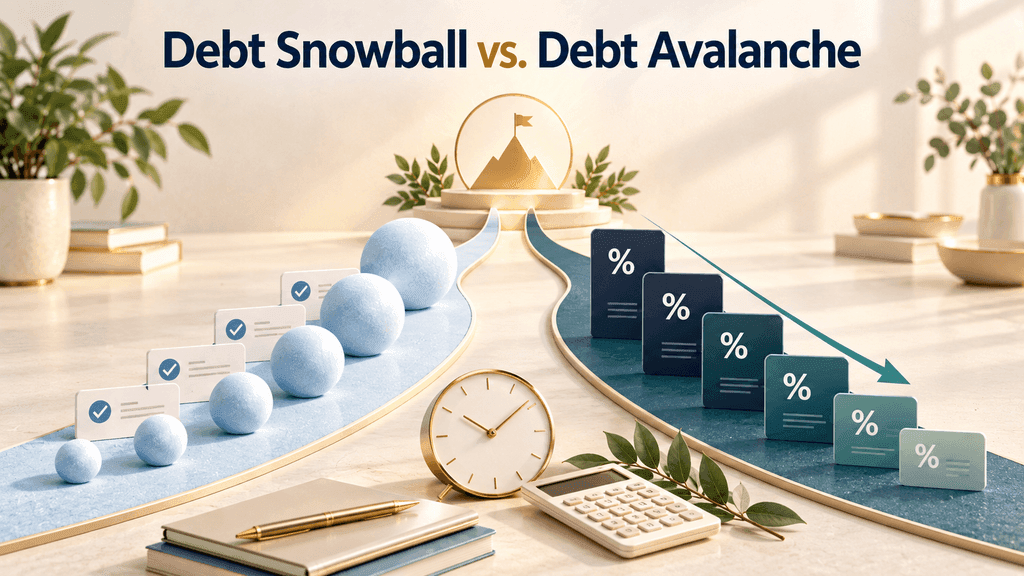
How the two methods differ
With the snowball, you send extra money to the smallest balance first. With the avalanche, by contrast, you send it to the debt with the highest interest rate first. In both cases, you keep making at least the required payment on every other debt. Then, when the target is paid off, its payment rolls over to the next one. The CFPB describes both as common debt reduction strategies.
| Question | Debt snowball | Debt avalanche |
|---|---|---|
| Which debt comes first? | Smallest balance | Highest interest rate |
| Main advantage | Earlier payoffs and visible wins | Lower interest cost |
| Possible drawback | May cost more in interest | First payoff can take longer |
| What keeps you going | Fewer debts on your list | Watching expensive debt shrink |
If both are followed with the same monthly budget, the avalanche usually costs less in interest.
Why small wins feel so powerful
If the avalanche usually saves money, why do so many people prefer the snowball? The answer is psychological. Paying debt can be discouraging, because you can send hundreds of dollars a month and still see the same number of accounts. Closing one account, however, gives you a clear sign of progress.
Research supports this. Kellogg School of Management professors David Gal and Blakeley McShane analyzed nearly 6,000 clients of a debt settlement program. As Kellogg Insight explains, the share of accounts people had paid off predicted whether they eliminated their debt better than the share of dollars paid off. Similarly, experiments by Alexander Brown and Joanna Lahey in the Journal of Marketing Research found that finishing small parts of a long task first can increase motivation to keep going.
However, the same tendency has a cost. In experiments by Moty Amar, Dan Ariely and colleagues, Winning the Battle but Losing the War, people kept paying off small debts first even when larger debts had higher interest rates. Interestingly, when participants were shown how much interest each debt was building up, they paid down their total debt faster.
This does not make the snowball cheaper. Rather, it explains why an early payoff feels bigger than the money involved. Motivation affects whether you stick with a plan, while interest rates decide what the plan costs. So the real choice is not between “logical” and “emotional”. Instead, it is about which plan you will actually finish, and how much you are willing to pay for that motivation.
How the debt snowball works
With the snowball, you list your debts from the smallest balance to the largest, regardless of interest rate. For example:
| Debt | Balance | APR | Required payment |
|---|---|---|---|
| Medical payment plan | $1,000 | 0% | $50 |
| Credit card | $4,000 | 27% | $120 |
| Personal loan | $6,000 | 11% | $150 |
Example debts used throughout this lesson.
Using the snowball, you would pay the minimums on the card and the loan while sending all your extra money to the $1,000 medical plan. Once it is gone, its payment moves to the credit card, and later the whole budget goes to the personal loan. As each account disappears, your payment grows, which is why it is called a “snowball”.
How the debt avalanche works
With the avalanche, you list your debts from the highest APR to the lowest, regardless of balance. So with the same debts, the order would be the credit card at 27%, then the personal loan at 11% and finally the 0% medical plan.
Every dollar sent to a 27% balance prevents more future interest than a dollar sent to a 0% balance. As a result, the avalanche usually reduces total interest. The drawback is that your first payoff can take much longer, so you may keep seeing every account on your list for months. To see why high-rate card debt grows so fast, read How Credit Card Interest Works.
The rules both methods share
- Pay at least the minimum on every debt. Skipping one to speed up another can lead to late fees, credit damage or default.
- Choose one target at a time. All extra money goes to that debt.
- Avoid adding new balances. Otherwise, you are filling the bucket while you empty it.
- Keep your total payment the same. When a debt is paid off, move its payment to the next target instead of spending it.
- Check how extra payments are applied. Some lenders may treat extra money as an early future payment unless you ask them to apply it to the principal.
The last point about keeping the total the same is what makes both methods work. If you were paying $600 a month in total, keep paying $600. That freed-up money is the momentum.
Cost comparison: the same debts, two orders
Let us run the numbers. Suppose the borrower can pay $600 a month in total. Since the minimums add up to $320, there is an extra $280 each month. The snowball sends it to the medical plan, while the avalanche sends it to the credit card. We assume monthly interest, fixed rates, no new purchases or fees, and that freed payments are redirected immediately.
| Result | Debt snowball | Debt avalanche |
|---|---|---|
| First debt paid off | Month 4 | Month 12 |
| All debts paid off | Month 21 | Month 21 |
| Total interest | $1,596.58 | $1,390.96 |
| Total repaid | $12,596.58 | $12,390.96 |
Original Money Behaves calculation. Simplified example with the three debts above and a $600 monthly budget.
Both methods finish in the same month, but the avalanche costs about $205.62 less. Meanwhile, the snowball gives the borrower a first win in month 4 instead of month 12. With larger balances or a bigger gap between interest rates, the difference in cost could be much larger. When rates are similar, on the other hand, it can be very small.
Compare both methods with your own debts
Use the planner below to see how the snowball and the avalanche would work with your real debts. It shows how long each method takes, how much interest you would pay and when you would see your first payoff.
How to use it: for each debt, enter the current balance, the APR and the minimum payment. You can find them on your statements or in your apps. Then enter the total you can pay toward all debts each month, which must be at least the sum of the minimums. The results update as you type.
TRY IT WITH YOUR NUMBERS
Snowball vs. avalanche planner
Enter up to four debts and your total monthly budget for debt. Leave unused rows at 0.
DEBT SNOWBALL
–
–
–
DEBT AVALANCHE
–
–
–
–
Simplified estimate. Interest is calculated monthly, rates and minimums stay the same, there are no new purchases or fees, and any money freed by a paid-off debt goes to the next target. Real statements may differ slightly.
Look at both numbers together: the interest difference and the months until your first win. If the snowball costs only a little more and the early win would keep you going, it may be a smart choice. If it costs much more, however, the avalanche or a mix of both may be better.
A hybrid approach
You do not have to follow either method perfectly. For example, you could pay off one very small balance first for a quick win, and then switch to the highest interest rate for everything else. Another option is to use the avalanche but celebrate smaller milestones, such as every $500 paid off or every 10% of the target balance. That way, you keep most of the savings while still seeing progress.
Build a safe repayment plan
Before choosing an order, list every debt with its balance, APR, minimum payment, due date and whether the rate is fixed or promotional. Then calculate: monthly debt budget − total minimum payments = extra money for the target.
Above all, do not build a plan so aggressive that it leaves nothing for rent, groceries, utilities, insurance or transportation. In addition, a small emergency fund can stop a surprise expense from going straight back onto a card.
Also, deal with urgent problems first. The smallest balance or highest rate is not always the most urgent debt. A past-due rent or mortgage payment, a car loan at risk of repossession, unpaid taxes or an account in collections may need attention before you optimize interest. If you cannot cover your minimums, contact your lenders early, because many offer hardship options, and consider a nonprofit credit counselor.
If your interest rates are very high, you may also want to compare a balance transfer or a consolidation loan, as explained in Balance Transfer vs. Debt Consolidation Loan and How a Debt Consolidation Loan Works.
Common mistakes
- “The snowball saves the most interest.” Usually not. It reduces the number of accounts fastest, but it often costs more.
- “The avalanche always ends much sooner.” Not necessarily. As our example shows, both can finish at the same time.
- “I should send everything to one debt.” No. Every other debt still needs its minimum payment.
- “When a debt is gone, I can spend its payment.” That breaks the rolling effect that makes both methods work.
- “I need the perfect method before I start.” In reality, starting now matters more than picking the perfect order.
Next time you plan your debt payments, check this
- List every debt. Write down the balance, APR, minimum and due date for each one.
- Run both methods. Compare the interest difference and the time to your first win.
- Decide what the motivation is worth. If the snowball costs a little more but keeps you going, that can be a fair trade.
- Keep your total payment the same. Roll every freed payment into the next debt.
- Stop adding new balances. Otherwise, no repayment order can work.
ABOUT THE AUTHOR
Lorena founded Money Behaves. She is an economist and a psychology student who focuses on how people make money decisions: how they judge risk, react to percentages and read costs, and what happens when financial information gets complicated. She is not a licensed financial advisor, so every lesson relies on official U.S. sources and published research. See how we write and check our lessons.
Keep learning: Minimum Payments: Why $90 Feels Right, Personal Loan vs. Credit Card Debt and How Credit Utilization Works.