When William moves into his first apartment, the leasing office asks for proof of renters insurance. He assumes the policy simply “covers the apartment”. In reality, the building belongs to the landlord, who insures it separately. William’s policy mainly protects his own belongings, his responsibility to other people and his extra costs if he has to move out for a while.
That difference is the key to understanding renters insurance. In fact, a policy does not cover every loss that happens in a rental home. Instead, it pays for specific losses, up to set limits, under specific conditions. So in this lesson, we explain the main protections, what they cost, the gaps that most often surprise tenants and how to check your own policy with an interactive scenario guide.

What renters insurance protects, and what it costs
Renters insurance, often called an HO-4 policy, is personal insurance for people who rent a house, an apartment or a condo. As the National Association of Insurance Commissioners explains, a landlord’s policy covers the building, but not the tenant’s possessions or the tenant’s liability.
It is also one of the cheapest types of insurance. According to the Insurance Information Institute, the average renters policy costs about $170 a year, or roughly $14 a month. However, prices vary a lot by state: based on NAIC data, renters in Mississippi paid about $256 a year, while those in North Dakota paid about $119.
The four main parts of a policy
First, your policy’s first page, called the declarations page, lists a separate limit for each part. Each one answers a different question:
| Coverage | What it is for | Simple example |
|---|---|---|
| Personal property | Your belongings after a covered loss | Clothes and furniture damaged by a fire |
| Personal liability | Claims that you injured someone or damaged their property | A fire you caused spreads to a neighbor’s unit |
| Additional living expenses | Extra costs if a covered loss makes your home unlivable | A hotel and meals while workers repair the apartment |
| Medical payments to others | Small medical bills for guests hurt in your home | A visitor needs stitches after a fall |
General descriptions. Your policy’s definitions, limits and exclusions decide what it actually pays.
See how a policy responds
The easiest way to understand these parts is to see them in action. So the guide below shows how a typical renters policy usually responds to six common events.
How to use it: tap or click an event. Then each row shows whether that part of the policy usually helps, sometimes helps or usually does not, with a short explanation.
Notice how a single event can involve several parts at once, while some events, such as a flood, involve none of them. That is why the useful question is never just “Am I covered?”, but rather “Which part of my policy would pay, and how much?”
Personal property: your belongings
In short, personal property coverage applies to things you own, such as furniture, clothing, electronics, kitchen items and bikes. However, the damage must come from an event the policy covers. For example, common covered causes include fire, smoke, theft, vandalism and certain types of sudden water damage, such as a burst pipe.
Also, coverage often follows you away from home. For example, as the NAIC notes, the policy may cover belongings stolen from your car or a hotel room, sometimes with a lower limit. Still, expensive items need a closer look, because many policies set special limits for jewelry, cash, collectibles and similar valuables. If you own something valuable, ask about adding it separately, often called scheduling the item.
Finally, how the insurer values your belongings matters a lot. Some policies pay what it costs to buy a new item, while others pay only what your old item was worth. We compare the two in Replacement Cost vs. Actual Cash Value.
Liability: when someone blames you
Liability coverage, however, is a different kind of protection. It may help if someone claims that you injured them or damaged their property, and it can also pay for your legal defense. For example, if William leaves food cooking and a fire spreads into the apartment below, his property coverage helps with his own things, while his liability coverage may respond to his neighbor’s claim.
Typically, many policies start with $100,000 of liability coverage, and raising it to $300,000 often costs only a little more. On the other hand, an injury in your home does not automatically make you responsible: the facts still matter, and the insurer will look at what caused it.
Additional living expenses
If a covered loss makes your home unlivable, this coverage may pay the extra costs of living somewhere else. In particular, the word “extra” matters. For instance, if William normally spends $400 a month on food and spends $650 while living in a hotel, the policy may help with the $250 difference, not the whole $650. Similarly, it does not pay simply because you decide to move or your lease ends.
MONEY TRAP
“I don’t own anything worth insuring”
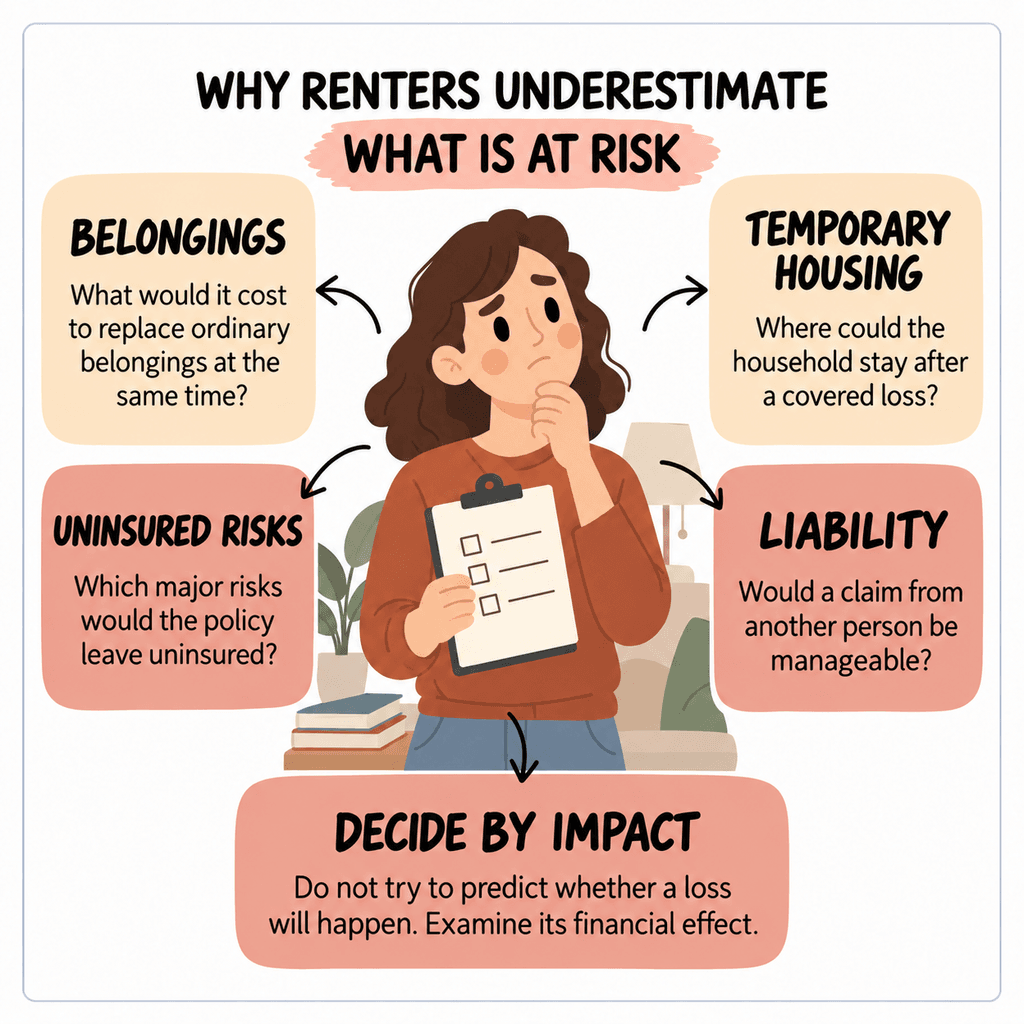
Most renters picture their belongings one at a time: an old sofa, a few clothes, a secondhand desk. Each item seems cheap, so the whole apartment seems cheap too. Yet replacing everything at once, at today’s prices, usually costs far more than people expect. Moreover, liability claims and a few weeks in a hotel have no object to count at all.
Fortunately, psychology helps explain this blind spot. In a review published in Current Biology, The Optimism Bias, neuroscientist Tali Sharot describes how people tend to underestimate their own chances of bad events, such as accidents or losses, while seeing them clearly for others.
So instead of asking “Will something happen to me?”, ask a more useful question: if it did happen, could I pay for it from my savings?
What renters insurance usually excludes
In short, an exclusion removes a certain cause of loss, type of property or situation from coverage. Policies differ, but these gaps surprise tenants most often:
- Floods and earthquakes. Standard policies usually exclude rising outside water and earth movement. Instead, flood coverage is available separately, for example through FloodSmart, the National Flood Insurance Program.
- Slow damage and pests. After all, insurance is not a maintenance plan, so gradual leaks, mold, insects and rodents are often excluded.
- Your roommate’s things. Also, sharing an address does not make someone an insured person, so unrelated roommates usually need their own policies.
- Business use. Similarly, equipment or inventory for a business you run from home may need separate coverage.
- Intentional damage. Finally, policies exclude damage or injuries caused on purpose.
Limits and deductibles
Next, two numbers shape every property claim. The limit is the most the policy will pay for a type of loss, while the deductible is the part you pay first. For example, with $15,000 of personal property coverage and a $500 deductible, a covered $4,000 theft would usually lead to a payment of about $3,500, depending on how the insurer values the items. We explain deductibles step by step in How Does a Renters Insurance Deductible Work?
How much coverage do you need?
Start with a simple home inventory instead of a guess. First, walk through each room, take photos or a short video, and write down what it would cost to replace the main items today. Most people find the total surprising, especially once they add clothes, kitchen items and electronics.
Then compare that total with the personal property limit, and check the liability limit, the deductible and how the insurer values items. Also, keep your inventory somewhere outside the apartment, such as in cloud storage, so you can reach it after a fire or a theft. Finally, update the policy when your life changes, for example when you move, get a pet, start working from home or buy something expensive.
Before you buy: five quick checks
- Property limit: does it match your home inventory total, or is it far below?
- Liability limit: is $100,000 enough for you, or would $300,000 cost only a few dollars more?
- Valuation: does the policy pay replacement cost or actual cash value?
- Deductible: could you comfortably pay it tomorrow from savings?
- Exclusions: do you need extra coverage for floods, earthquakes, valuables or a home business?
To compare offers fairly, line them up with the same limits and deductibles, as we explain in How to Compare Insurance Quotes. Otherwise, a cheaper quote may simply be offering less coverage.
Common questions
Is renters insurance required by law?
No state requires it by law, but many landlords require it in the lease. Even when it is optional, it is often one of the cheapest ways to protect yourself from a large loss.
Does my landlord’s insurance cover my belongings?
Usually not, because the landlord’s policy covers the building and the landlord’s own liability. So your furniture, clothes and electronics need your own renters policy.
Does renters insurance cover my car?
No. Auto insurance handles damage to your car, as explained in our car insurance deductible lesson. However, your renters policy may cover belongings stolen from inside your car.
ABOUT THE AUTHOR
Lorena founded Money Behaves. She is an economist and a psychology student who focuses on how people make money decisions: how they judge risk, react to percentages and read costs, and what happens when financial information gets complicated. She is not a licensed financial advisor, so every lesson relies on official U.S. sources and published research. See how we write and check our lessons.