Olivia gets two prices for the same car insurance policy. The coverage and limits are identical; only the deductible changes. With a $500 deductible, she would pay $1,560 a year, while with a $1,000 deductible, she would pay $1,390.
At first glance, choosing $1,000 saves her $170 a year. In return, she accepts up to $500 more of the cost when a covered claim is large enough. So which is better? The cheaper premium may win if she goes several years without a claim, whereas the lower deductible may win if an accident happens soon. In addition, there is a question no formula can answer: could Olivia actually pay $1,000 if the car needed repairs tomorrow?
Start with the real trade-off
A car insurance deductible is the part of a covered damage claim that you pay yourself. It usually applies to collision and comprehensive coverage, as explained in Comprehensive vs. Collision Car Insurance. According to the NAIC Consumer’s Guide to Auto Insurance, higher deductibles generally mean lower premiums, because you keep more of each loss.
For example, if a covered accident causes $4,000 in damage:
| Deductible | You pay | Insurer pays (simplified) |
|---|---|---|
| $500 | $500 | $3,500 |
| $1,000 | $1,000 | $3,000 |
Simplified example. Real claims can include other terms and limits.
So the real question is not “which number looks safer?”. Instead, it is: how much extra am I paying each year to reduce my share of a future claim by up to $500?
MONEY TRAPWhy the low deductible feels safer
“The $500 deductible is the responsible choice. I do not want a big bill if something happens.”
Olivia pays $170 more every year to cut her share of a claim by $500. After about three years without a claim, she has paid more for that protection than it can give back.
Why the low deductible can feel safer than it is
A low deductible turns an uncertain future expense into a certain, smaller payment spread across the year. For many people, that feels more comfortable, even when the extra premiums add up to more than the protection they buy.
Psychologists Daniel Kahneman and Amos Tversky explained part of this in Prospect Theory, published in Econometrica: losses tend to feel bigger than gains of the same size. A sudden $1,000 repair bill feels like a painful loss, while a slightly higher premium feels like a normal cost of living. As a result, we may pay a lot to avoid that one painful moment.
Real data also shows the same pattern. Economist Justin Sydnor studied thousands of real homeowners insurance choices in (Over)insuring Modest Risks, in the American Economic Journal: Applied Economics. He found that many households chose low deductibles even though they were paying far more than the extra coverage was likely to be worth. That study was about home insurance, not cars, so it does not tell you which deductible to choose. However, it shows how much people are willing to pay for peace of mind.
Of course, that peace of mind can be worth something, especially if a big bill would cause real problems. The goal is simply to know its price. For Olivia, three years of the lower deductible cost $510 extra, which is more than the $500 it could save on one claim.
Calculate the break-even point
The basic formula is:
Break-even years = difference between deductibles ÷ yearly premium savings
For Olivia, the deductible difference is $1,000 − $500 = $500, and the yearly savings are $1,560 − $1,390 = $170. Therefore, $500 ÷ $170 = 2.94 years, or about two years and eleven months.
| Time with the policy | Saved with $1,000 deductible | If no claim | After one big claim |
|---|---|---|---|
| 1 year | $170 | $1,000 ahead by $170 | $500 ahead by $330 |
| 3 years | $510 | $1,000 ahead by $510 | $1,000 ahead by $10 |
| 5 years | $850 | $1,000 ahead by $850 | $1,000 ahead by $350 |
Original Money Behaves calculation. Assumes stable premiums, one claim large enough for the full deductible and no other differences between the policies.
Reaching 2.94 years does not make the $1,000 deductible better forever. It only shows when the savings equal one full $500 difference. Also, keep in mind that this is not a prediction of whether you will have an accident.
The claim has to be big enough
The lower deductible does not give you a $500 advantage in every case. If damage is below both deductibles, neither policy pays. And if it falls between $500 and $1,000, the advantage is smaller:
| Covered damage | Payment with $500 | Payment with $1,000 | Advantage of $500 |
|---|---|---|---|
| $400 | $0 | $0 | $0 |
| $800 | $300 | $0 | $300 |
| $1,500 | $1,000 | $500 | $500 |
| $5,000 | $4,500 | $4,000 | $500 |
Simplified payments. Real claims can include taxes, fees and other policy terms.
On the other hand, a deductible usually applies to each claim. So two large claims could give the lower deductible a $1,000 advantage in total. A one-claim calculation cannot cover every possible future.
Pass the cash test
Break-even math compares totals over time. However, a repair bill arrives all at once. Olivia might save $510 over three years with the $1,000 deductible. Yet if she has an accident in the first month, she needs $1,000 right away, before saving much at all.
This matters because many households have little cash set aside. According to the Federal Reserve’s Survey of Household Economics and Decisionmaking, only about 63% of U.S. adults said they would cover a surprise $400 expense with cash or its equivalent. In other words, for many people, a $1,000 deductible would mean borrowing.
If you would have to put the deductible on a high-interest credit card, the interest could wipe out several years of premium savings, as we show in Minimum Payments: Why $90 Feels Right. For that reason, think of the deductible as an amount you agree to cover yourself, and ideally keep it in savings, for example in a high-yield savings account.
Also, if your car is financed or leased, check the agreement before changing the deductible. Lenders often require collision and comprehensive coverage and may limit how high your deductible can be.
Run the numbers with your own quotes
Next, use the calculator below to find your break-even point and check whether you could actually afford the higher deductible today.
How to use it: ask your insurer for two quotes on exactly the same policy, one with each deductible. Enter both deductibles and both yearly premiums. Then enter how much savings you could use today without touching money for rent, food or bills. The results update as you type.
TRY IT WITH YOUR QUOTES
Deductible break-even calculator
Compare a lower and a higher deductible on the same policy, and check whether you could pay the higher one today.
BREAK-EVEN POINT
–
–
–
CASH CHECK
–
–
–
Simplified estimate. Assumes the same coverage and premiums every year and one covered claim large enough for the full deductible to apply. It does not predict how likely a claim is, and premiums can change at renewal.
Try changing only the premium savings. If the higher deductible saves you $90 a year instead of $250, the break-even point moves from two years to more than five, so it is always worth asking for the real price of both options.
What the calculation cannot tell you
- Premiums can change at renewal. So recalculate each year with your current quotes rather than an old difference.
- A claim may affect future premiums or discounts. However, that depends on the event, the insurer and your state, so it cannot be known in advance.
- Your car’s value sets the limit. A low deductible does not make the insurer pay more than the car was worth or cover the rest of a loan.
- It does not predict accidents. The break-even point only shows how long the savings take to add up.
Finally, when you ask for quotes, make sure only the deductible changes. If the limits, drivers or discounts also change, the price difference no longer measures the deductible alone. The method in How to Compare Insurance Quotes Without Comparing the Wrong Coverage can help.
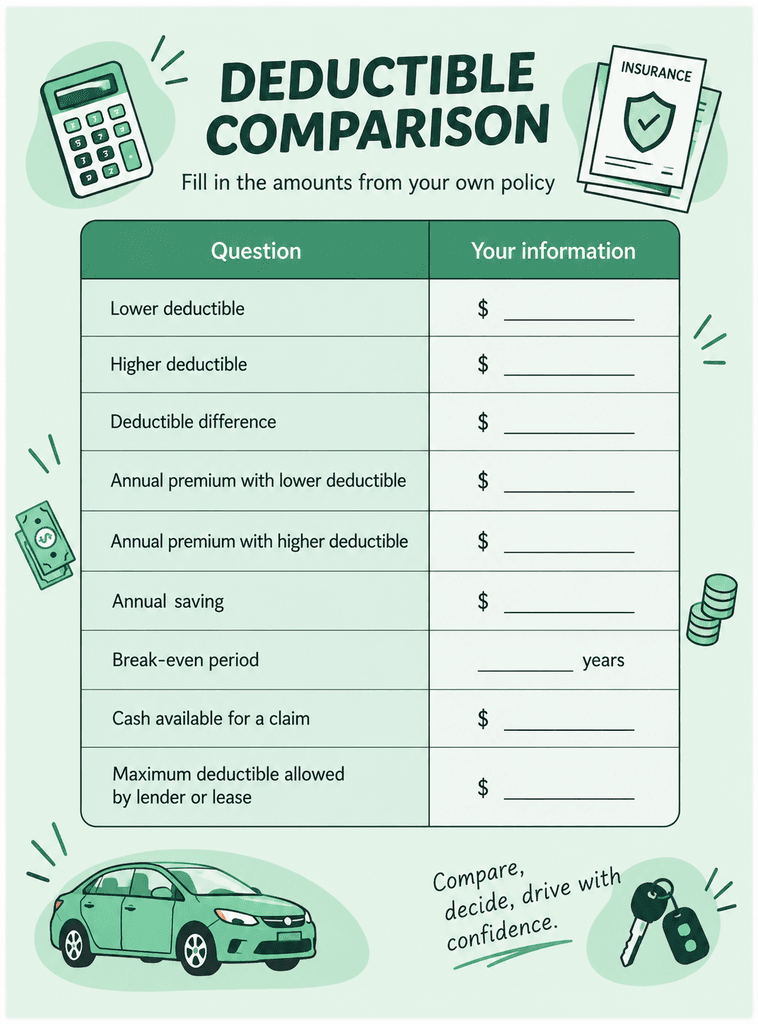
Next time you choose a deductible, check this
- Ask for two quotes on the same policy. Change only the deductible.
- Find your break-even point. Divide the deductible difference by the yearly premium savings.
- Check your savings. Choose a deductible you could pay today without borrowing.
- Put a price on peace of mind. Decide how much extra premium the lower deductible is really worth to you.
- Review it every year. As your savings grow, a higher deductible may start to make sense.
ABOUT THE AUTHOR
Lorena founded Money Behaves. She is an economist and a psychology student who focuses on how people make money decisions: how they judge risk, react to percentages and read costs, and what happens when financial information gets complicated. She is not a licensed financial advisor, so every lesson relies on official U.S. sources and published research. See how we write and check our lessons.
Keep learning: Comprehensive vs. Collision Car Insurance, How a Renters Insurance Deductible Works and HMO vs. PPO Health Insurance.