Two insurance quotes can show different prices because the companies charge different rates. However, they can also differ because they are not pricing the same insurance at all. One quote may cover six months instead of twelve, carry lower liability limits, use a higher deductible or leave out a rental car after a claim.
Indeed, that difference matters more than it seems. For example, a quote that looks $300 cheaper may simply be offering less protection. And more people are comparing than ever: LexisNexis reported that the rate of drivers shopping for auto insurance hit an all-time high at the end of 2025, while the NAIC found the average combined premium reached $1,438 per insured vehicle in 2023. So in this lesson, we show how to compare quotes fairly, with a real example and an interactive quote checker.

The one rule that makes prices comparable
First, before requesting any quote, decide which features every company should price. Then give each insurer the same information about the people, cars or property, and their use. Only after those items match should the premium decide anything.
Fortunately, this is easier than reading every policy from start to finish. You are not trying to become an insurance expert. Instead, you are simply making sure that each price describes the same thing. Also, keep in mind that a quote is an estimate, not a contract: the insurer may still check your driving record, claims history or property details before issuing the policy.
Build a baseline before you open quote websites
In practice, quote forms often begin with pre-filled choices, and those defaults may differ from one company to another. So if you accept each site’s defaults, you may end up comparing three different policies without noticing.
Instead, write a short baseline first. For example, for a car, it could list the liability limits, uninsured motorist coverage, collision and comprehensive deductibles, rental reimbursement and roadside help. Similarly, a renters baseline could list the personal property limit, liability limit, deductible and whether the policy pays replacement cost, as explained in Replacement Cost vs. Actual Cash Value. Then enter exactly the same choices on every site.
Also, if you are unsure what your state requires, or whether a state licenses a company, use the NAIC’s directory of state insurance departments.
State regulators also publish plain-language guides you can use to build your list. California’s Department of Insurance, for example, explains each part of a car policy in its automobile insurance guide.
A real example: $840 vs. $1,860
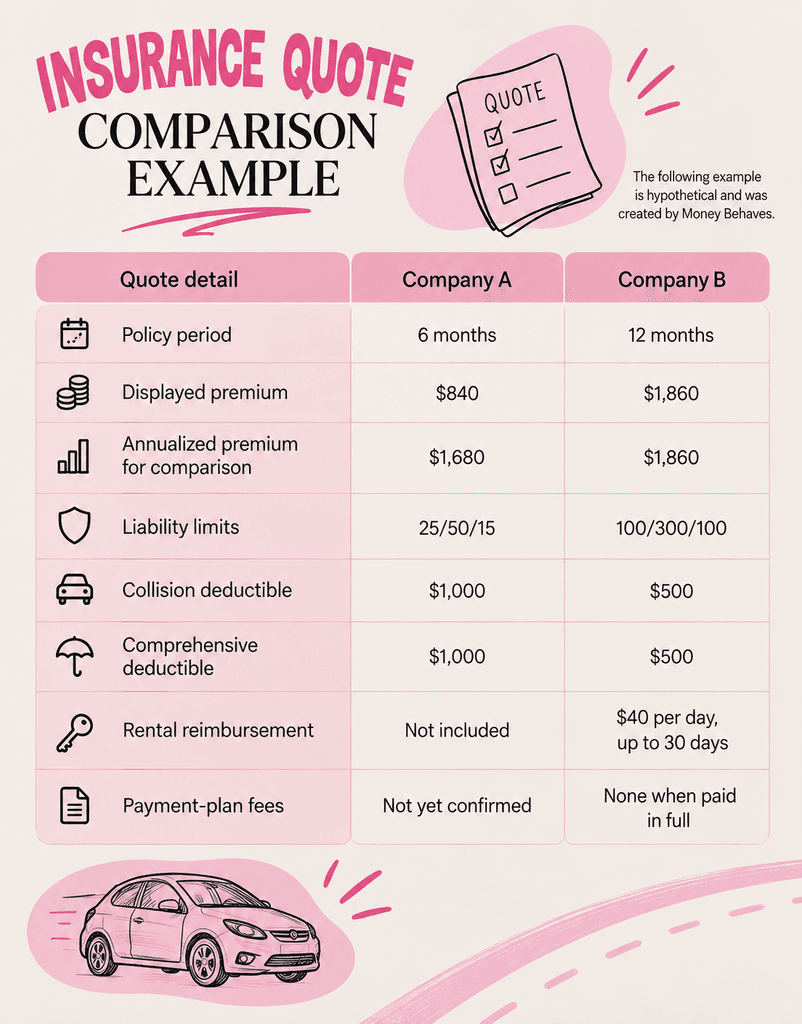
Here is a hypothetical example created by Money Behaves, in which two companies quote the same driver and the same car:
| Quote detail | First quote (A) | Second quote (B) |
|---|---|---|
| Policy period | 6 months | 12 months |
| Price shown | $840 | $1,860 |
| Price per year | $1,680 | $1,860 |
| Liability limits | 25/50/15 | 100/300/100 |
| Collision deductible | $1,000 | $500 |
| Comprehensive deductible | $1,000 | $500 |
| Rental car after a claim | Not included | $40 a day, up to 30 days |
Hypothetical figures. Liability limits appear in thousands of dollars: injury per person, injury per accident and property damage.
At first glance, $840 looks far cheaper than $1,860. However, one price covers six months and the other a full year, so Company A really costs $1,680 a year. Even then, the $180 difference does not buy the same protection: Company A has much lower liability limits, higher deductibles and no rental car.
Now imagine Company A quotes $990 for six months once it prices the same limits, deductibles and rental coverage. Its yearly price becomes $1,980, so after matching the terms, Company A is actually $120 more expensive. In other words, the cheaper-looking quote was never the cheaper deal.
Check your own quotes
Next, use the checker below to compare two quotes you have received. In short, it converts both prices to a yearly amount, adds what you would pay after one claim and flags every mismatch.
How to use it: for each company, type the price on the quote, the policy period, the collision deductible, the liability limits, whether a rental car is included and any yearly fees. The example already shows the two quotes above, so you can start by changing them. As a result, the chart and the warnings update as you go.
Then try setting both quotes to the same limits, deductible and rental option. You will see the warnings disappear one by one, and only then does the price difference tell you something real.
Turn every price into a yearly cost
Insurers may show prices per month, per six months or per year. So first convert them to the same period. After that, look for charges outside the headline price, such as installment fees for paying monthly, a required membership or a policy fee. A fee of $5 a month, for instance, adds $60 a year, as we explain for cards in Credit Card Fees: 6 Myths That Cost You Money.
Discounts, too, deserve the same care. A “15% discount” is not the number that matters; the final yearly price for matching coverage is. Also, some discounts are temporary or depend on conditions, such as a driving-tracking app, so ask how long they last.
Find out why a quote is cheaper
However, when one matching quote is much cheaper, look for the reason rather than celebrating the price. In particular, check the features that would move more of the cost back to you after a loss:
- Lower limits, so the insurer pays less in a large claim.
- Higher deductibles, so you pay more first. See $500 vs. $1,000 Car Insurance Deductible.
- Missing optional coverage, such as rental or roadside help.
- A different valuation method, such as actual cash value instead of replacement cost.
- Exclusions or special limits that remove certain losses.
- A shorter policy period, such as six months instead of twelve.
MONEY TRAP
The price is easy to judge, the coverage is not
A premium is a familiar dollar amount, so we can tell at a glance whether $840 is “good”. By contrast, a liability limit of 25/50/15 means very little to most people. As a result, the number we understand wins the decision, even when the number we skip matters more.
Psychologist Christopher Hsee called this the evaluability problem in a peer-reviewed study in Organizational Behavior and Human Decision Processes, The Evaluability Hypothesis: features that are easy to judge get too much weight. Defaults add to the effect. In a famous study in the Journal of Risk and Uncertainty, Framing, Probability Distortions, and Insurance Decisions, Eric Johnson and colleagues showed that drivers in New Jersey and Pennsylvania mostly kept whichever car insurance option their state set as the default.
So treat every pre-filled field on a quote form as a suggestion, not a recommendation, and compare the coverage before you look at the price.
Check the company, not just the brand
Each state regulates its own insurance market, and a familiar brand may sell policies through several legal companies. So look for the exact company name on the quote. Then you can check whether your state licenses it and find consumer information, such as complaint data, through the NAIC’s Consumer Insurance Search.
Complaint numbers need context, though. A large company may receive more complaints simply because it has more customers, so compare complaint ratios rather than raw totals. Finally, think about practical service: how you report a claim, when the company is available and whether it has local repair shops or agents.
Before you switch: check the new policy
Once you choose a quote, read the declarations page of the new policy before canceling the old one. In particular, check the names, cars or property, limits, deductibles, optional coverages, dates and price. If anything differs from the quote, contact the insurer right away and keep a copy of the quote.
Above all, never cancel your current policy until the new one is active. Even one day without car insurance can be costly, and in many states it is illegal to drive uninsured.
A final comparison checklist
- Information: are the people, cars or property described accurately and identically?
- Period: have you converted every price to a yearly cost?
- Coverage: do the limits, deductibles and optional coverages match?
- Valuation: do the policies pay the same way after a loss?
- Fees and discounts: are they included, and do they last?
- Company: have you checked the legal insurer in your state?
- Affordability: could you pay the deductible after a claim?
- Timing: is the new policy active before the old one ends?
Common questions
How many insurance quotes should I get?
Typically, many experts suggest at least three. More quotes can help, but only if you enter the same baseline each time, so the comparison stays fair.
Does getting a quote affect my credit score?
Usually not. In fact, in many states, insurers may check a credit-based insurance score, but a quote request is generally a soft inquiry, which does not affect your credit score.
Is the cheapest quote ever the best choice?
Yes, as long as it offers the same coverage, from a reliable company, with deductibles you could afford. After all, paying more for identical protection makes little sense.
ABOUT THE AUTHOR
Lorena founded Money Behaves. She is an economist and a psychology student who focuses on how people make money decisions: how they judge risk, react to percentages and read costs, and what happens when financial information gets complicated. She is not a licensed financial advisor, so every lesson relies on official U.S. sources and published research. See how we write and check our lessons.